Fruit Vegetable Processing
 Nuts Processing Solution
 Pastry Processing Solution





A cocoa line’s “capacity” is only meaningful when you know which material point it refers to. A line rated at 500 kg/h of raw cocoa beans does not automatically produce 500 kg/h of nibs, cocoa liquor, cocoa butter, cocoa cake or cocoa powder. Shell removal, process losses, press matching, operating time and packaging all affect the final amount you can ship. Before comparing quotations, define your target product, the capacity basis, expected operating schedule and the raw-bean conditions used for the calculation.
Why a 500 kg/h Label Is Not a Finished-Product Capacity
Capacity labels are useful only as a starting point. In cocoa processing, the material changes at every major stage:
Raw cocoa beans → cleaned beans → roasted beans → cocoa nibs → cocoa liquor (also called cocoa mass) → cocoa butter and cocoa cake → cocoa powder.
Each stage has a different purpose, material condition and output basis. A cracking and winnowing section may be described by the quantity of beans it receives. A grinder may be described by the cocoa liquor it processes. A press may be described by the cocoa liquor feed rate or by its cake discharge cycle. A powder section may be described by cake feed or by finished powder output.
This is why two suppliers can both offer a “500 kg/h cocoa processing line” while describing different systems.
| Capacity statement | What it may mean | What it does not confirm |
|---|---|---|
| 500 kg/h raw cocoa beans | Beans entering the cleaning, roasting or winnowing section | Nib, liquor, butter or powder output |
| 500 kg/h cocoa nibs | Winnowed nibs available for grinding | The raw bean intake required to produce those nibs |
| 500 kg/h cocoa liquor | Liquor entering a holding tank, press or downstream process | The resulting cocoa butter and cake quantities |
| 500 kg/h press feed | Cocoa liquor supplied to the press | Finished powder output or powder specification |
| 500 kg/h cocoa powder | Powder at the specified final process point | The required bean intake, operating hours and packaging rate |
For a project quotation to be comparable, you need the supplier to state the basis in the same way: raw material, process point, product specification and operating conditions.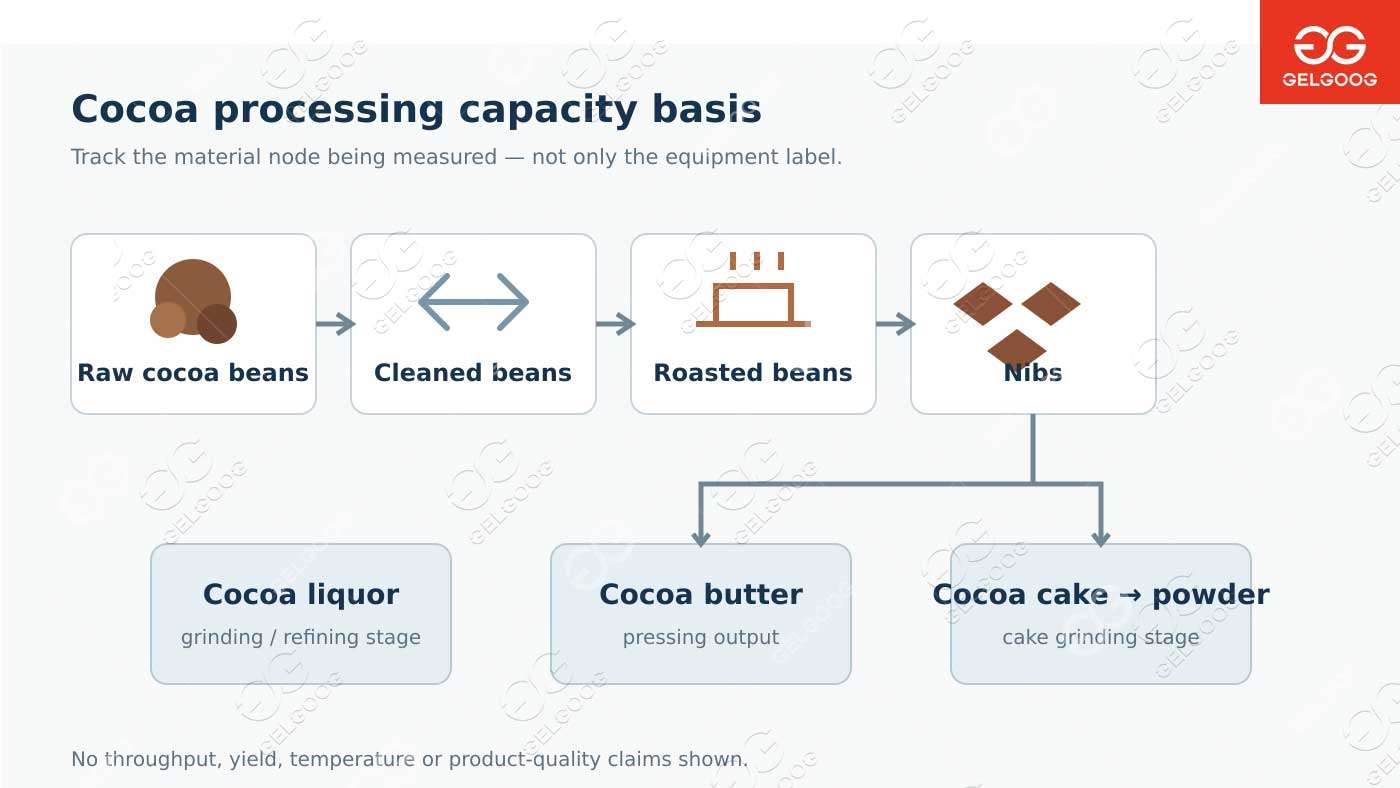
Define the Product You Need to Ship Before Sizing the Line
The first question is not “What capacity machine do I need?” It is: What product must leave your factory, in what quantity, and during what operating period?
Your commercial target may be one of the following:
cocoa nibs supplied to a chocolate producer;
cocoa liquor supplied in blocks, containers or bulk form;
cocoa butter for food, confectionery or another downstream use;
cocoa cake for further sale or internal grinding;
natural or alkalized cocoa powder with a specified fat content, color and particle-size range.
These products require different equipment boundaries. A project producing cocoa liquor does not need the same downstream scope as a project producing cocoa powder. A powder project must also consider cocoa butter collection, cake handling, grinding, classification and the required powder specification.
The cocoa processing solution can be used as a process reference, but the actual scope should be defined around your final commercial product rather than a broad equipment list.
When you request a quotation, describe the required product in practical terms:
target product and intended buyer;
required output per hour, shift, day or year;
natural or alkalized powder requirement, if powder is the target;
target fat content, color and particle-size requirement, where applicable;
packaging format and pack weight;
planned production schedule;
whether you will process one bean origin or multiple origins.
This information turns a general capacity discussion into a project calculation.
Map Capacity Across the Actual Cocoa Process
A complete cocoa line is a connected system, not a group of machines with identical nameplate values. The line should be checked from intake through to the final product point.
| Process section | Capacity basis to confirm | Key condition affecting the result |
|---|---|---|
| Cleaning and sorting | Raw bean feed rate | Bean moisture, foreign matter, bean size distribution and pre-cleaning condition |
| Roasting and cooling | Raw bean feed rate and roasting residence time | Bean origin, target flavor profile, moisture and required roast level |
| Cracking and winnowing | Raw bean feed rate and nib recovery basis | Shell content, bean size variation, breakage and separation adjustment |
| Grinding | Cocoa nib feed rate or cocoa liquor output | Nib condition, target fineness and downstream liquor handling |
| Pressing | Cocoa liquor feed rate, cycle arrangement and cake discharge | Liquor properties, target butter extraction and cake handling |
| Cake grinding and powder handling | Cake feed rate and finished powder specification | Required particle size, fat content, color, cooling and packing arrangement |
| Packing | Finished product rate by pack size | Packaging format, filling method, weighing accuracy and changeover frequency |
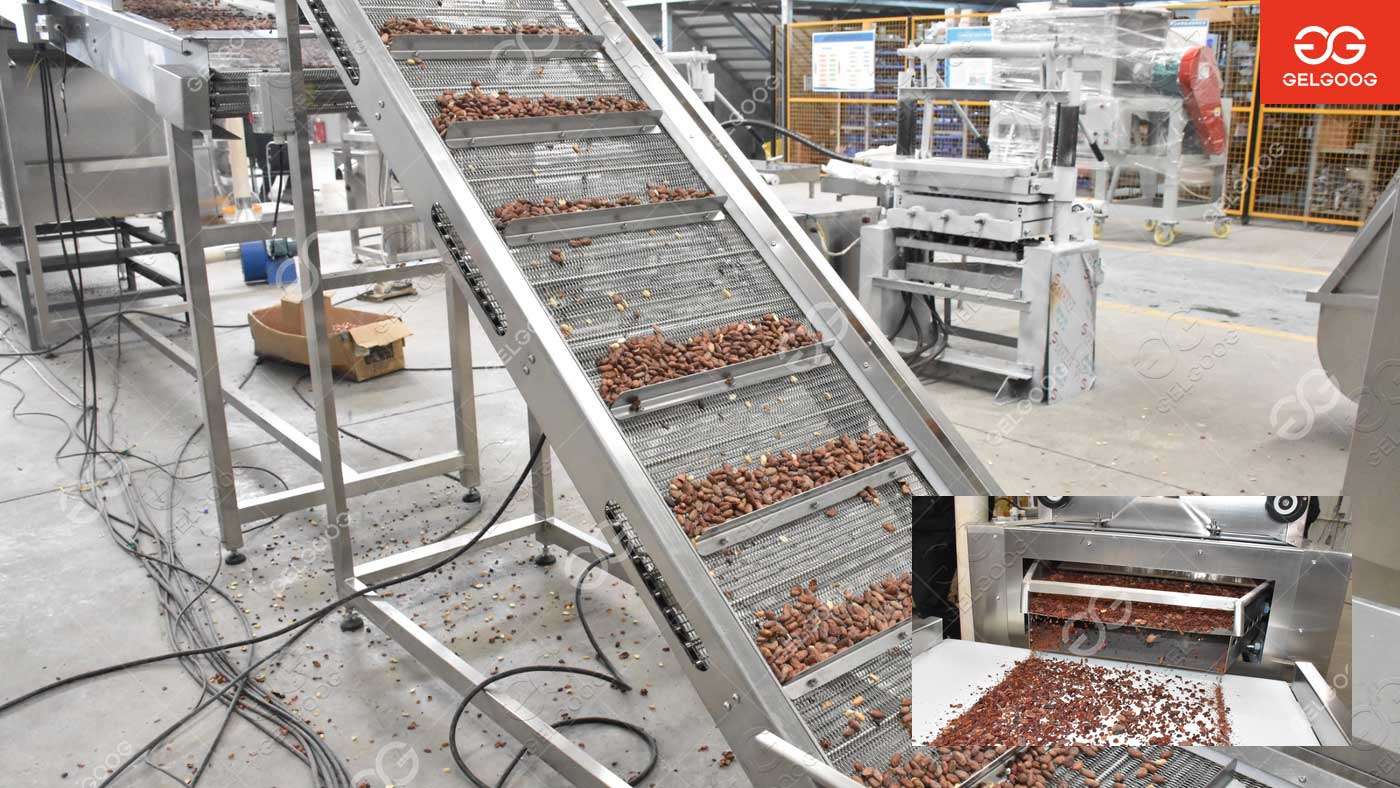 The cocoa roasting and cooling machine and cocoa winnowing equipment should therefore not be evaluated in isolation. Their real suitability depends on whether their feed capacity, product condition and discharge rhythm match the next section.
The same applies to the cocoa butter press. Its role is not simply to “make powder.” It separates cocoa liquor into cocoa butter and cocoa cake. The press section, butter handling, cake conveying and powder section need to be matched around the required products and operating plan.
Calculate Backward From the Required Finished Output
A practical capacity calculation starts from the product you need to ship, then works backward through the process.
For a cocoa powder project, the planning relationship can be expressed as:
Required raw bean input = required packed powder output ÷ total verified process yield
The total verified process yield is not one fixed number. It depends on several project-specific elements, including:
accepted raw bean condition;
shell proportion and achievable nib recovery;
handling and transfer losses;
press performance under the defined liquor and process conditions;
powder specification and classification requirements;
rejected or reworked material;
packaging and finished-product acceptance criteria.
This means you should avoid planning a cocoa project with a single assumed conversion figure copied from another factory. Different bean origins, quality conditions and product specifications can change the calculation.
For a cocoa liquor project, the backward calculation is shorter, but the same principle applies. You still need to establish whether capacity means raw bean intake, nib output or finished cocoa liquor available for packing or transfer.
A supplier should be able to show the material balance as a project document, with each stage clearly identified. If the quotation gives only one overall capacity figure, ask where that figure is measured and what material conditions it assumes.
Include Operating Time, Changeovers and Packaging in the Capacity Plan
Hourly capacity alone does not define your usable production output. A project also needs an operating schedule.
You may have a required annual volume, but your line will operate according to real factory conditions: shifts, cleaning, product changes, planned maintenance, raw material supply and packing availability. The production plan should therefore distinguish between:
rated machine capacity under defined conditions;
planned production hours per shift or day;
available operating days per year;
time for cleaning, inspection and maintenance;
planned changeovers between products or packaging formats;
practical packing capacity for the final product.
For example, a powder grinding section may be technically able to process a defined cake feed rate, while the packing section becomes the practical limit because of a small pack size, a manual handling step or frequent product changes.
The same issue can occur at the front of the line. If beans arrive with high foreign matter, variable size or different moisture conditions, the cleaning, roasting and winnowing settings may need adjustment. This may affect the production schedule even when the machine nameplate capacity remains unchanged.
A realistic capacity plan should therefore include both the equipment calculation and the operating assumptions behind it.
Ask Every Supplier to Complete the Same Capacity Sheet
The most reliable way to compare options is to give each supplier the same project brief and request the same capacity information. This reduces the risk of comparing raw-bean intake from one quotation with finished powder output from another.
| Information to request | Why it matters |
|---|---|
| Target final product | Defines whether the project ends at nibs, liquor, butter, cake or powder |
| Required output and time basis | Distinguishes hourly, per-shift, daily and annual requirements |
| Raw material description | Shows the bean condition used for equipment selection and yield evaluation |
| Capacity basis for each process section | Reveals whether adjacent sections are properly matched |
| Material balance | Shows expected product streams and where losses or by-products are considered |
| Utilities and operating conditions | Helps assess practical installation scope |
| Product specification | Ensures the line is designed around the required output, not only throughput |
| Validation method | Clarifies what must be checked through samples, trials or FAT |
You should also ask where the bottleneck is expected to be. In a well-defined project, the supplier should identify the process section that sets the line’s practical throughput and explain how upstream and downstream equipment are matched to it.
This approach is especially important when planning a modular line. You may start with a cocoa liquor project and reserve space for pressing later, or start with pressing and add more powder capacity as demand grows. In either case, the first-phase layout, transfer points and utilities should be reviewed against the intended future capacity—not only the first equipment purchase.
Confirm the calculation against your project conditions
A capacity calculation is a design basis, not a substitute for validation. Before final equipment selection, confirm the conditions that influence the result:
representative cocoa bean samples, where available;
bean origin and expected variation;
target product and specification;
expected operating schedule;
required utility conditions;
packaging format and downstream handling;
project layout and expansion requirements.
For higher-value projects, the capacity and product assumptions should be reviewed during technical discussions and confirmed through the agreed testing or factory acceptance process.
The useful result is a line definition that states where capacity is measured, which section limits throughput, and what finished product the plant can deliver under the agreed conditions.
FAQ
Is raw cocoa bean input the same as finished cocoa powder output?
No. Raw beans pass through cleaning, roasting, winnowing, grinding, pressing and powder processing. Each stage changes the material stream, and cocoa butter is separated from cocoa liquor during pressing. Finished powder output must be calculated from the required product specification and verified process conditions.
Why can two cocoa line quotations show the same capacity but have different scopes?
The quoted number may refer to different material points. One supplier may state raw bean intake, while another may state nib feed, cocoa liquor flow, press feed or finished powder output. Always request a process-by-process capacity basis.
Should I size a cocoa line by hourly output or daily output?
Use both. Hourly output helps match equipment sections, while daily and annual output show whether the project meets your commercial requirement under the planned shifts, cleaning time, changeovers and maintenance schedule.
Does the cocoa butter press determine the final powder capacity?
Not by itself. The press is a critical section, but powder capacity also depends on cake handling, grinding, classification, cooling, packing and the required powder specification. The entire downstream section should be checked as one system.
How can I validate the expected capacity before placing an order?
Provide representative product requirements and raw-material information, request a detailed capacity sheet and material balance, and agree on the points to be verified through sample evaluation, technical review or factory acceptance testing.
Define Your Capacity Basis Before You Request a Final Quotation
If you are planning a cocoa nibs, cocoa liquor, cocoa butter or cocoa powder project, send GELGOOG your target product, planned output, production schedule, cocoa bean information, site conditions and expansion plan.
We can help define the capacity basis at each process section, identify the likely bottleneck and list the assumptions that need sample evaluation or FAT confirmation before the equipment scope is finalized.
Request a cocoa line capacity review