Fruit Vegetable Processing
 Nuts Processing Solution
 Pastry Processing Solution





For a pear packhouse planning to process 2–3 tonnes per hour, choosing the right sorting line involves more than matching a machine's rated capacity. The system must inspect colour and visible surface defects, route pears to 12 packing outlets, and maintain packing continuity without excessive handling damage or congestion.
Twelve packing outlets do not necessarily mean twelve commercial grades. Their allocation depends on pear varieties, quality requirements, expected grade distribution and packing speed. For an existing fruit packhouse, the proposed line must also fit the available space and connect with current packing operations.
1. What Should a 2–3 T/H Pear Sorting Project Achieve?
An established packhouse needs consistent fruit quality and reliable packed output, not simply faster sorting.
For a facility handling different fruits or seasonal packing programmes, four questions guide the project:
Quality: Can the system distinguish acceptable colour variations from defects that affect commercial grading?
Capacity: Can the sorter maintain 2–3 t/h incoming throughput while the packing outlets operate?
Flexibility: Can outlets be reassigned when grade distribution or customer orders change?
Integration: Can the new sorting section work with existing packing tables, conveyors and cold-storage logistics?
A compact sorting machine is not necessarily a compact packing solution. Twelve outlets also need room for operators, carton handling and fruit discharge.
In practice, the sorter and packing area need to be reviewed together.
2. What Equipment Is Needed for Colour and Defect Sorting?
A pear sorting line usually combines controlled feeding, fruit separation, optical inspection, grading and outlet distribution.
| Process stage | Main function | Planning consideration |
|---|---|---|
| Bin or crate feeding | Introduce pears into the line | Gentle unloading and transfer |
| Singulation | Separate fruit for inspection | Stable spacing and presentation |
| Optical inspection | Assess colour and external defects | Variety-specific grading criteria |
| Grading and routing | Direct fruit to assigned outlets | Accurate tracking and discharge |
| 12 packing outlets | Deliver graded fruit to packing stations | Outlet loading and packing capacity |
| Carton handling | Transfer packed products | Connection with existing logistics |
The GELGOOG fruit sorting system provides a reference for intelligent fruit grading equipment. Pear-specific inspection requirements and the proposed 12-outlet configuration must be evaluated separately.
Colour and Defect Inspection Are Different Tasks
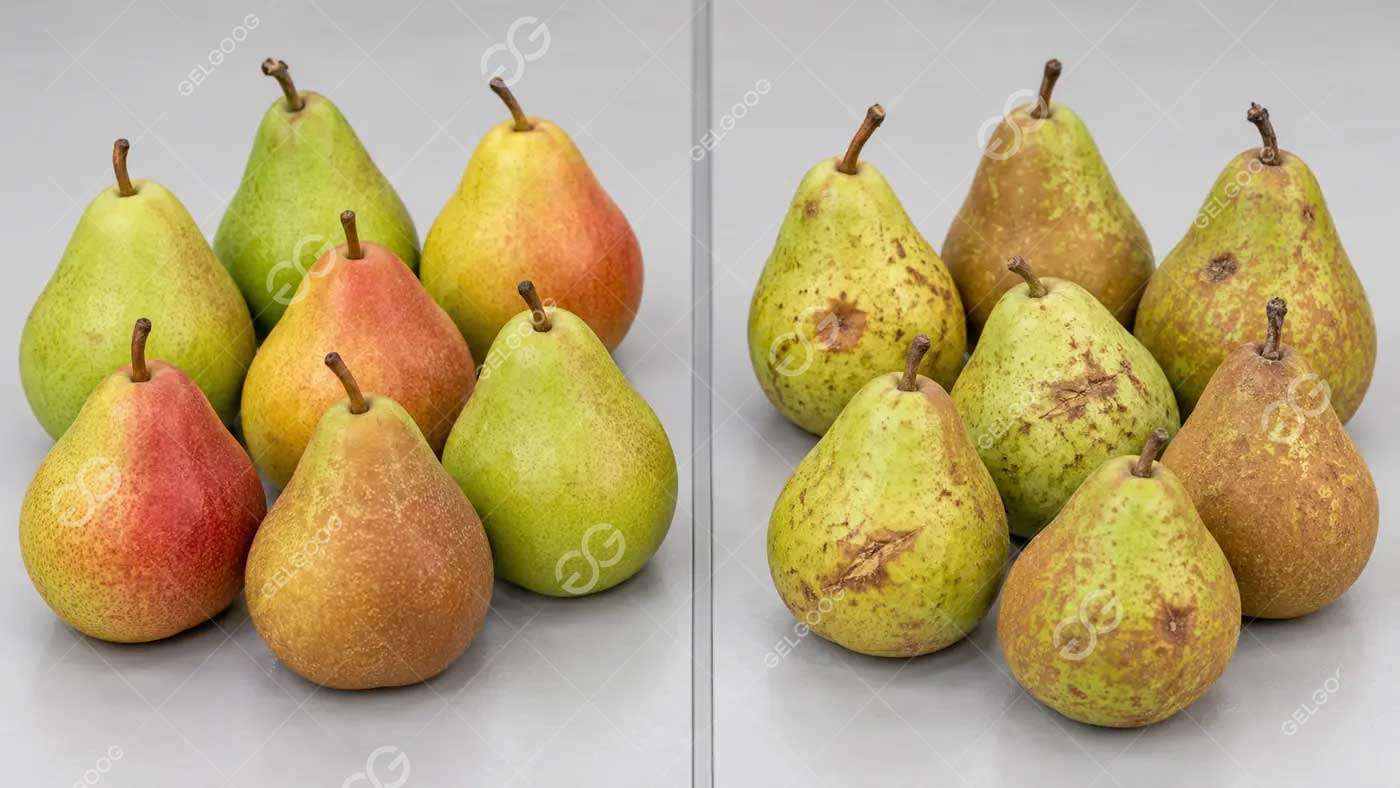
Colour grading may consider background colour, colour coverage and variations relevant to a particular pear variety.
Defect inspection identifies surface conditions against agreed commercial standards. These may include agreed blemishes, skin damage, visible marks consistent with handling damage, or other surface conditions defined in the commercial specification.
Several pear characteristics influence inspection:
Variety: Natural colour and russeting vary between pears.
Shape: Stem, neck and shoulder areas can complicate inspection coverage.
Presentation: Fruit orientation affects which surfaces are visible.
Defect appearance: Some damage is difficult to distinguish from normal skin characteristics.
Natural russeting, for example, may be acceptable for one variety or market but unsuitable for another.
Visible external inspection must also be distinguished from internal-quality assessment. Firmness, internal defects and sugar content require separately specified measurement methods where applicable.
Before selecting inspection equipment, representative samples should be classified against the packhouse's own quality standards. This allows the proposed system to be evaluated against real commercial grading decisions.
3. How Should 12 Packing Outlets Be Allocated?
Twelve outlets provide flexibility, but assigning one commercial grade to each outlet can create unnecessary bottlenecks.
Consider a packhouse where premium-quality pears represent most of the incoming crop. Sending that grade to a single outlet could overload its packing station while other outlets remain underused.
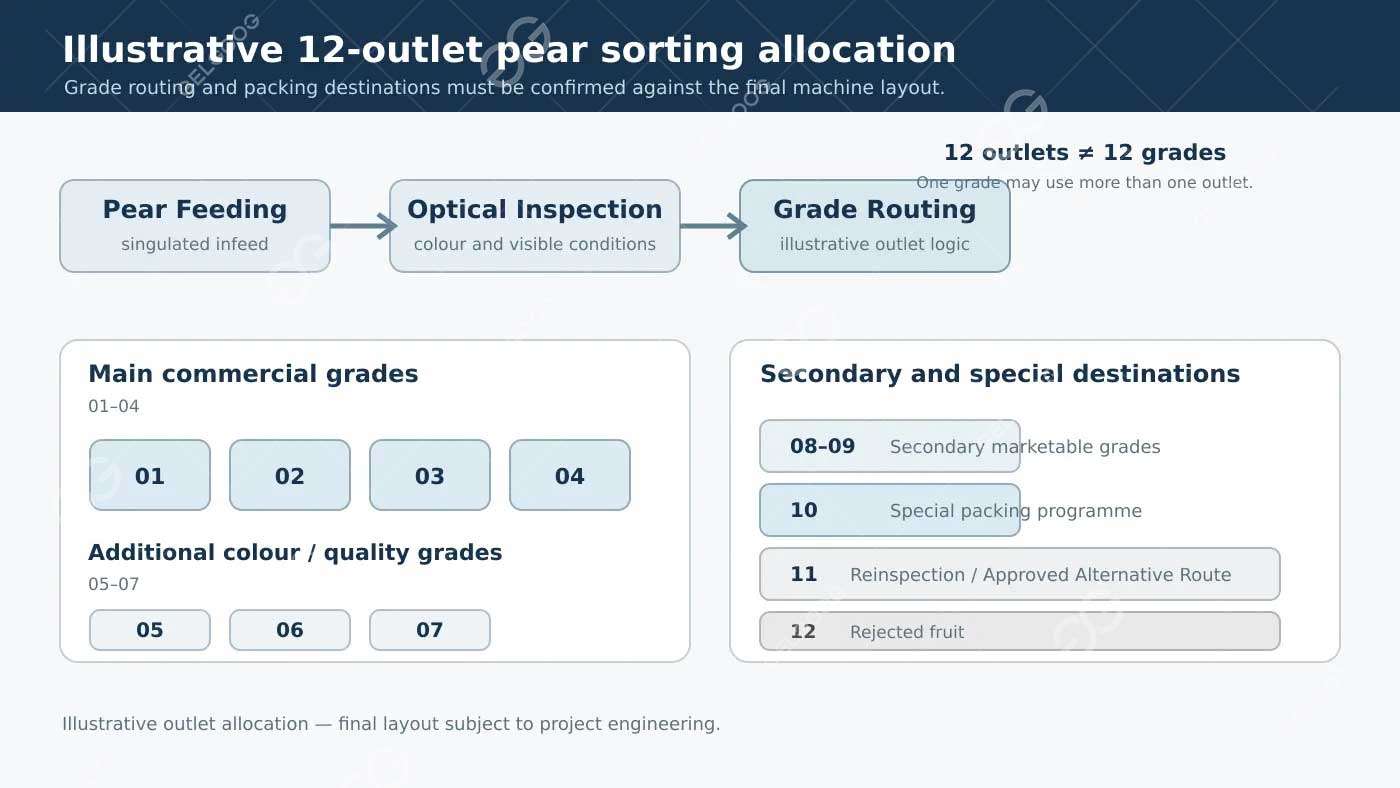
An illustrative arrangement is shown below.
| Outlet group | Possible assignment | Purpose |
|---|---|---|
| 1–4 | Main commercial grades | Handle higher-volume fruit |
| 5–7 | Additional colour or quality grades | Meet different customer specifications |
| 8–9 | Secondary marketable grades | Separate acceptable lower-grade fruit |
| 10 | Special packing programme | Accommodate changing orders |
| 11 | Reinspection or an approved alternative route | Handle fruit requiring further assessment or an alternative destination permitted by the packhouse's quality procedures |
| 12 | Rejected fruit | Separate unsuitable product |
This is a planning example, not a final outlet configuration.
The outlet plan only becomes clear after the packhouse maps its expected grade mix and packing workload.
High-volume grades may need several outlets. Lower-volume categories may require fewer, depending on packing speed and the available routing controls.
Twelve outlets, twelve commercial grades and twelve sorting lanes are different concepts. Their functions should be defined independently during equipment planning.
Need to Check Whether 12 Outlets Match Your Packing Plan?
Share your pear varieties, target grades, expected grade mix and current packing arrangement.
GELGOOG can help map outlet allocation, packing interfaces and likely bottlenecks before final configuration.
4. How Much Fruit Can a 2–3 T/H Line Actually Pack?
Rated sorting capacity and packed output are not interchangeable.
A 2–3 t/h requirement should specify whether the figure refers to incoming pears, fruit successfully inspected and routed, or acceptable packed product.
| Capacity measure | Definition | Why it matters |
|---|---|---|
| Nominal infeed capacity | Pears entering the line per running hour | Defines feeding and sorting requirements |
| Effective sorting throughput | Fruit inspected and routed during operation | Reflects sorting continuity and interruptions |
| Scheduled-hour packed output | Acceptable packed pears over scheduled production time | Reflects operating time, marketable yield and packing performance |
Example: 2.5 T/H Infeed Capacity
For planning only, a nominal infeed rate of 2.5 t/h with an average pear weight of 180 g is equivalent to approximately 13,900 pears per running hour, or 231 pears per minute.
This is the nominal fruit rate while running, before downtime is considered.
If the project uses an illustrative 85% planned running factor and a 90% marketable-fruit assumption:
2.5 t/h × 85% × 90% = 1.91 t/h
The result is approximately 1.91 tonnes of marketable fruit per scheduled hour, assuming downstream packing can handle the marketable flow without additional losses.
Both percentages are hypothetical planning inputs, not verified operating results.
Actual packed output will move with the pear mix, operating time, outlet loading and packing performance.
Why Average Outlet Capacity Can Be Misleading
At 2.5 t/h, dividing incoming fruit equally among twelve outlets produces an average of approximately 208 kg per outlet per running hour.
Actual sorting rarely creates equal distribution.
One outlet may receive considerably more fruit because a particular grade dominates the batch. The packing team, accumulation capacity and carton supply must be able to handle those peak loads.
The busiest outlets, rather than the mathematical average, are therefore the better starting point for evaluating packing capacity.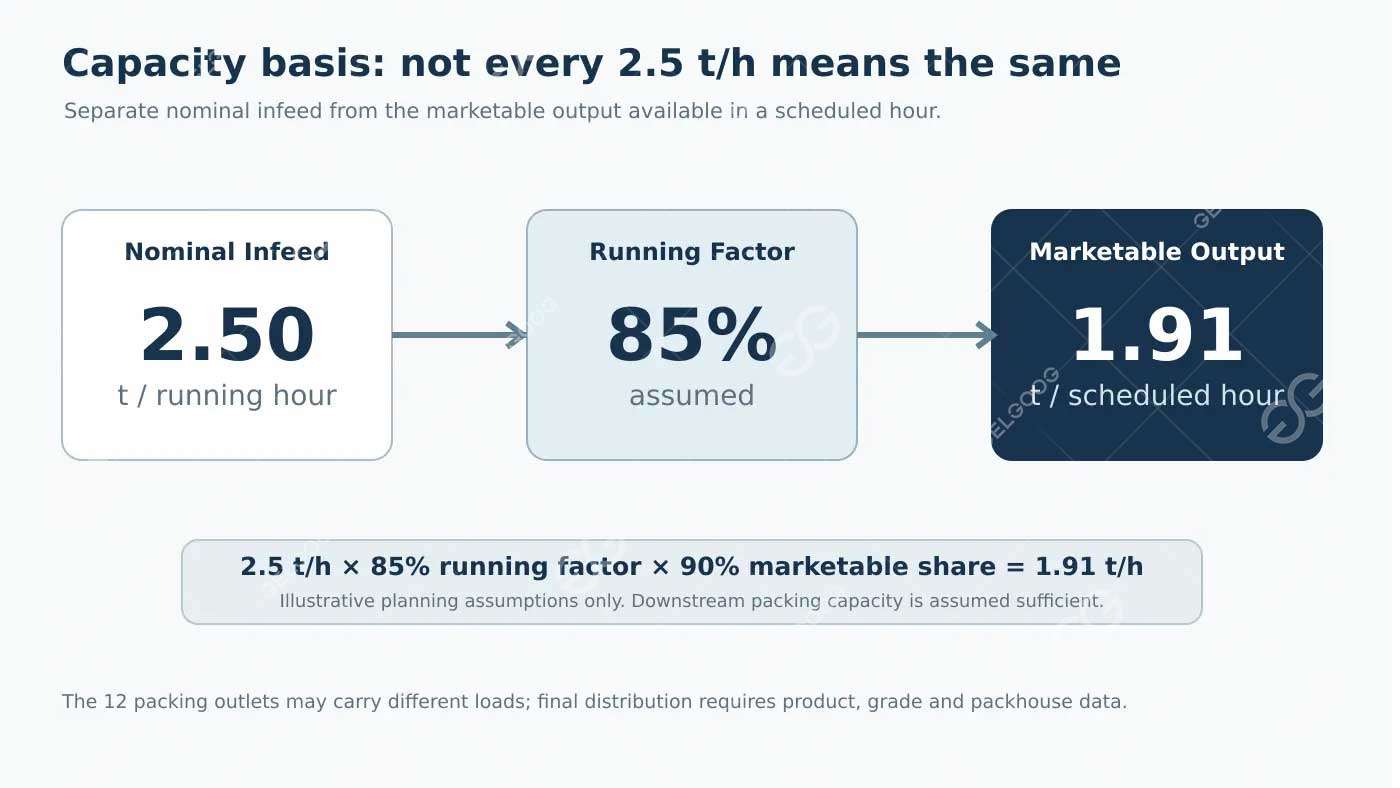
5. Can an Existing Apple Packhouse Be Adapted for Pear Sorting?
An existing fruit packhouse may already have usable conveyors, packing stations, carton-handling equipment and cold-storage connections.
Retaining compatible equipment can avoid unnecessary replacement and simplify integration.
However, an apple handling system cannot automatically be treated as suitable for pears. Fruit shape, skin characteristics, transfer conditions and discharge behaviour may differ.
A retrofit review should cover the following interfaces.
| Existing operation | Pear-specific question |
|---|---|
| Fruit unloading | Will the existing method avoid unacceptable pressure or impact damage? |
| Feeding and conveying | Can pears be separated and transported consistently? |
| Inspection | Can the system accommodate pear shape and variety-specific criteria? |
| Packing outlets | Can existing stations handle the expected grade distribution? |
| Seasonal changeover | Can the required programmes and routing arrangements be changed efficiently? |
| Floor space | Is there sufficient room for 12 outlets, operators and maintenance access? |
The first review should show which existing sections can stay, which need modification, and where a new module is unavoidable.
Optional washing or other preprocessing stages may also be considered where required. GELGOOG's fruit washing and grading solution illustrates related equipment categories, but their suitability for a pear project depends on the fruit condition and intended process.
For a working packhouse, the proposed layout should be reviewed alongside existing production schedules and material movement.
6. What Should Be Verified During Sample Testing and Acceptance?
A useful trial should mirror the grading choices the packhouse makes on a normal production day.
Samples should represent the actual pear varieties, sizes, colour differences, natural skin conditions and commercially relevant defects.
Before testing, the packhouse and supplier should agree on reference classifications for acceptable fruit, secondary grades and rejection.
| Test area | Acceptance question |
|---|---|
| Colour and defect inspection | Do results agree with approved commercial grading references? |
| Inspection coverage | Are relevant fruit surfaces sufficiently visible? |
| False rejection | Are acceptable pears incorrectly removed from commercial grades? |
| Handling damage | Does the equipment introduce unacceptable additional damage? |
| Outlet routing | Does fruit reach its assigned packing destination? |
| Throughput | Can the line sustain the agreed operating rate? |
| Packing continuity | Can packing stations handle uneven grade loads? |
| Changeover | Can agreed grading and routing programmes be adjusted? |
Detection performance, outlet routing and packed output should be evaluated separately.
A sorter may identify a grade correctly while congestion at the receiving outlet reduces production. Similarly, a successful demonstration at reduced speed does not establish performance at the required throughput.
Sample testing and factory acceptance testing (FAT) should use agreed operating conditions and measurable criteria. Final values require confirmation using representative fruit.
7. What Information Is Needed for an Initial Line Proposal?
A complete factory engineering package is not necessary for the first discussion.
For a 2–3 t/h project with twelve packing outlets, the most useful information includes:
Pear varieties: Typical sizes, photographs and surface characteristics.
Grading requirements: Colour categories, visible defect criteria and reject rules.
Expected grade mix: Approximate proportions of different quality categories.
Capacity: Incoming tonnes per running hour, operating schedule and target packed output.
Existing layout: Available space, current conveyors and packing stations.
Packing arrangements: Carton sizes, manual or automated packing and downstream handling.
With these inputs, GELGOOG can map the likely outlet loading, assess equipment integration and identify which assumptions need a pear sample trial before preparing a technical quotation.
Frequently Asked Questions
Can a pear sorter inspect both colour and visible defects?
A suitably specified optical system may assess both. Supported defect types, inspection coverage and accuracy must be validated with representative pears.
Do twelve outlets require twelve grades?
No. Multiple outlets can serve high-volume grades, subject to the proposed routing system and packing layout.
Can existing apple packing equipment be reused?
Potentially. Unloading, transfer, singulation, discharge and packing compatibility must be evaluated for pears.
Should the quoted 2–3 t/h refer to incoming or packed fruit?
Both figures should be defined separately. Incoming throughput determines sorting requirements; packed output reflects running time, accepted fruit and downstream capacity.
Request a Pear Sorting and Outlet-Planning Review
For a pear sorting project targeting 2–3 t/h with 12 packing outlets, share your pear varieties, commercial grading criteria, expected grade mix and existing packing arrangement.
GELGOOG can help prepare a preliminary process configuration, review outlet allocation, identify potential packing bottlenecks and establish which inspection requirements need sample validation.
The review can provide a clearer basis for selecting equipment modules, assessing integration with existing facilities and preparing a technical quotation.
Request a Pear Sorting and Outlet-Planning Review
Or discuss your project via WhatsApp: +86 18537181190.