
 Fruit Vegetable Processing
 Nuts Processing Solution
 Pastry Processing Solution






A biscuit tunnel oven should not be selected simply by choosing “gas” or “electric” from a supplier’s quotation. The right heating arrangement depends on the biscuit you plan to produce, how the dough behaves during baking, the required colour and final texture, your available utilities, and the way the oven must connect with forming, cooling, and packaging.
A thin cracker, a rotary-moulded biscuit, a soft cookie, and a centre-filled product can all pass through a tunnel oven, but they may not require the same baking profile. Before finalising the oven length, heating source, zones, belt arrangement, or control system, you need to confirm what your target biscuit must achieve at the oven discharge—and what conditions your factory can support.
For an initial view of the available equipment scope, see GELGOOG’s Industrial Baking Tunnel Oven for Biscuit & Cake. The final configuration should still follow your actual product and factory conditions.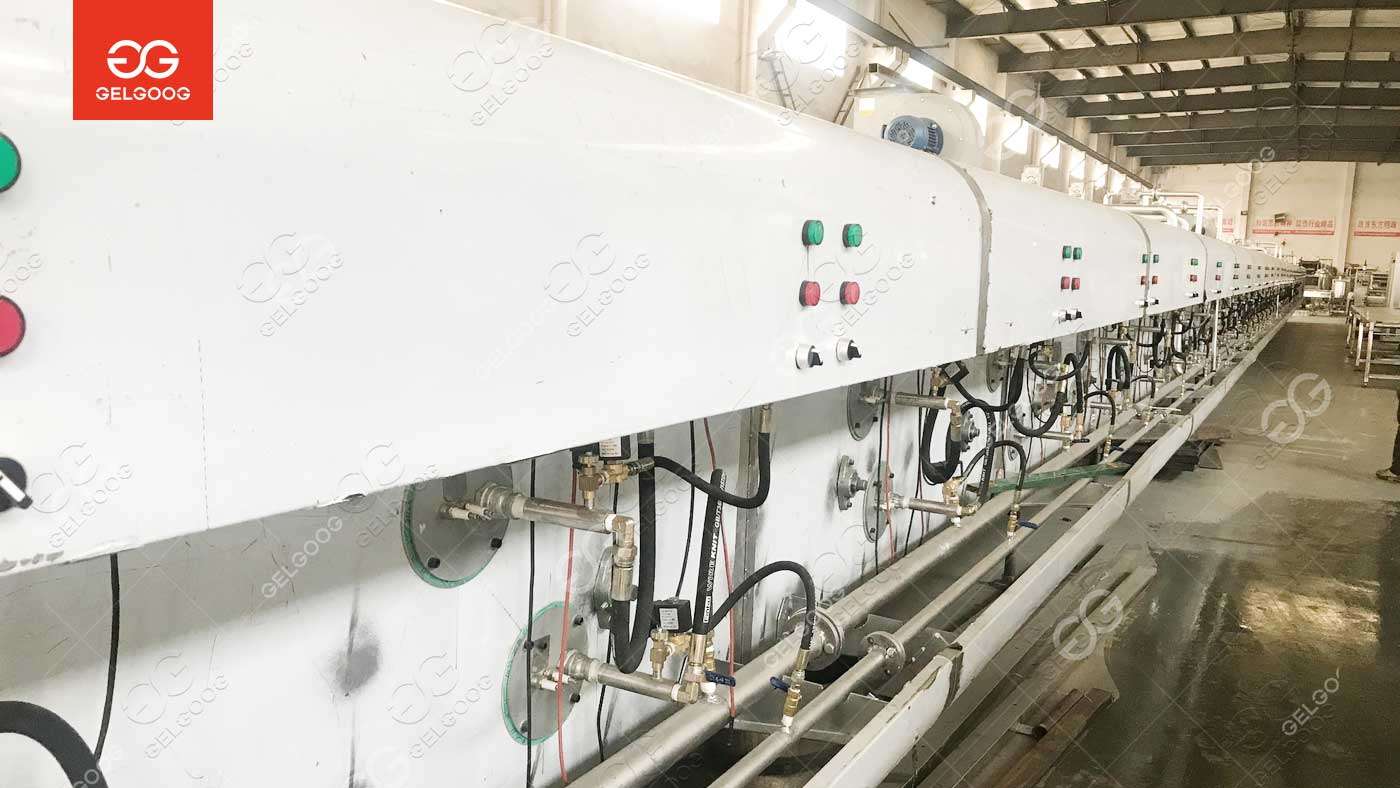
Start With the Biscuit You Need to Bake
The first question is not:
“Should I buy a gas or electric biscuit tunnel oven?”
The better question is:
“What baking conditions does my main biscuit need to reach the required colour, texture, moisture condition, shape, and handling strength?”
For example, a thin, crisp cracker may need a different heat-transfer pattern from a thicker cookie with a soft centre. A product with detailed surface relief may need to retain its form without excessive spread. A biscuit that will later become a sandwich product must be stable enough for cream depositing, capping, and packaging.
Before requesting a tunnel-oven proposal, prepare:
the finished biscuit photo;
biscuit dimensions, thickness, and piece weight;
product type and main recipe characteristics;
target texture, colour, and moisture condition;
whether the product contains sugar, fat, fillings, inclusions, or layers;
target production schedule;
planned packaging format;
available gas, electricity, ventilation, and factory space;
existing forming, cooling, and packing equipment.
This does not mean you need to provide a final industrial recipe at the first discussion. But without a clear product target, a heating-source recommendation will only be a preliminary assumption.
Compare Gas and Electric Heating Against Your Project Conditions
Gas and electric tunnel ovens are not automatically “best” or “worst” choices. Each should be evaluated against the product, local utility conditions, operating schedule, maintenance capability, and factory design.
| Heating approach | May be considered when | Questions to confirm before selection |
|---|---|---|
| Gas heating | The factory has a reliable gas supply and plans continuous industrial production | What gas type and pressure are available? Is safe installation, exhaust, combustion-air supply, and local compliance feasible? |
| Electric heating | The project has suitable electrical infrastructure, or gas is unavailable or impractical | Is the electrical supply sufficient for the planned oven and other equipment? What will the operating cost and load-management requirements be? |
Fuel cost matters, but it is only one part of the oven decision. The heating choice also affects installation work, utility connections, control logic, maintenance planning, safety systems, and factory layout.
When comparing quotations, ask each supplier to state the assumed gas type, electrical load, ventilation scope, safety provisions, and site work excluded from the equipment supply.
Need to Compare Gas and Electric Oven Options?
Send your biscuit photo, target output, planned operating hours, available gas and electrical information, and factory layout. GELGOOG can help define the initial oven basis, utility questions, and connected cooling requirements for your project.
For a project with uncertain product development, the most important point is to avoid assuming that one heating arrangement will automatically suit every future biscuit. The final selection should follow the primary commercial product, while secondary products are evaluated separately.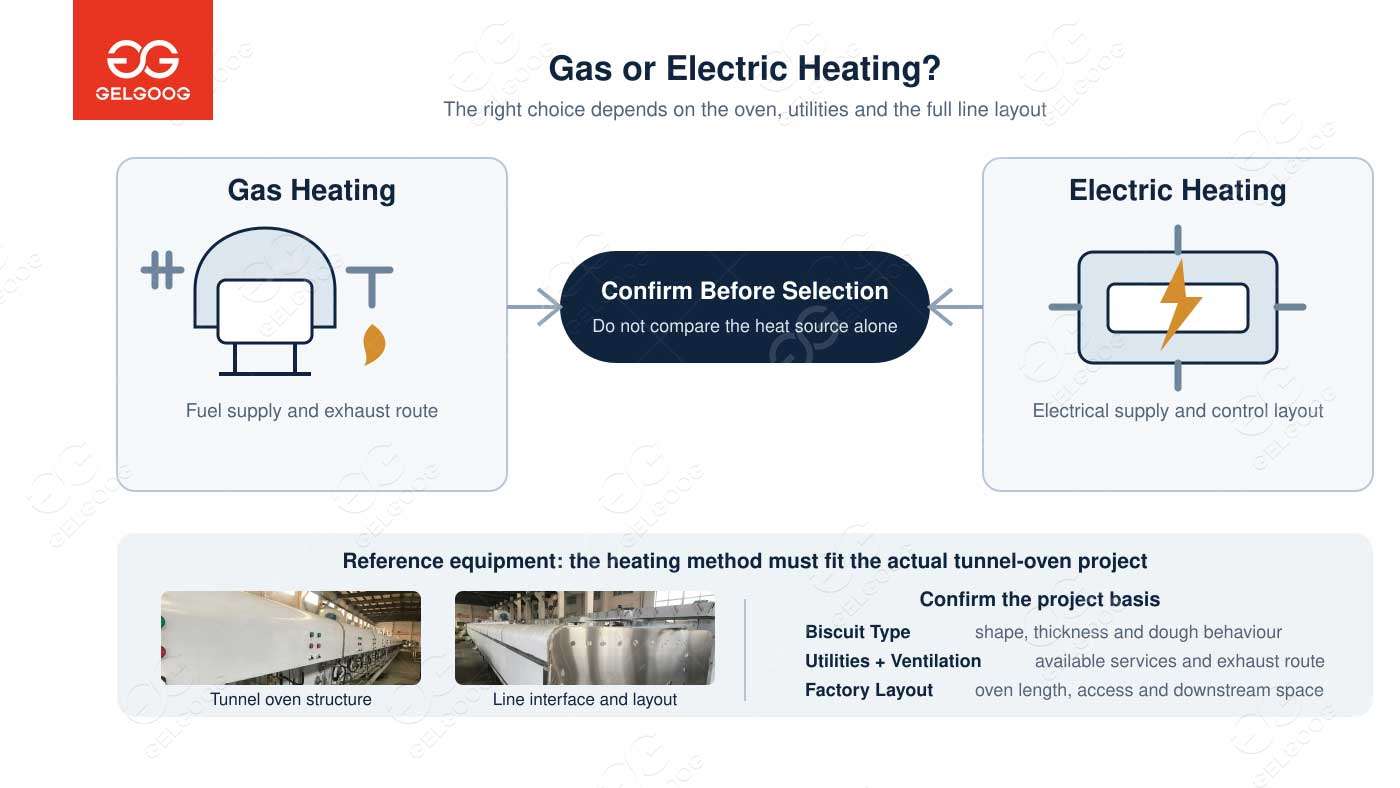
Your Biscuit Determines the Baking Profile
A tunnel oven works as part of a complete thermal process. The product enters with a specific shape, thickness, dough condition, and moisture level, then leaves the oven with a new structure that must be suitable for cooling, handling, and packing.
The oven should therefore be discussed in relation to the following product behaviours.
Shape retention and surface detail
If the biscuit has an embossed pattern, a detailed edge, perforations, or a controlled shape, the baking profile should support that design. Too much early expansion, insufficient setting, or an unsuitable baking curve can affect the appearance even when the forming section is operating correctly.
This is especially relevant for moulded biscuits, rotary-cut biscuits, and products that need to look consistent in retail packaging.
Colour development
Biscuit colour is not only a visual preference. It can indicate whether the baking process is stable across the belt width and through the planned production time.
Before accepting an oven configuration, define what “acceptable colour” means for your product. This may include the top surface, bottom surface, edges, colour consistency between pieces, and whether the product is likely to darken further during post-oven handling.
A product that needs a light, uniform finish may require a different control approach from a darker, more caramelised biscuit. The desired result should be confirmed through product evaluation rather than a general statement that an oven provides “uniform baking.”
Moisture and texture
A crisp cracker, a hard biscuit, and a soft cookie do not have the same moisture and texture targets. The oven needs to achieve the intended product condition without creating excessive breakage, an unstable structure, or a result that cannot be packed properly after cooling.
The baking result also depends on factors outside the oven itself, including dough consistency, piece thickness, belt loading, forming accuracy, cooling conditions, and ambient factory conditions. For this reason, oven performance should be evaluated with the intended product, not only through empty-machine specifications.
Fillings, sugar, fat, and inclusions
Products containing centre fillings, high sugar levels, high fat levels, chocolate pieces, nuts, seeds, or fruit inclusions require additional evaluation. These ingredients can influence spreading, colour development, heat transfer, cleaning requirements, and product handling after baking.
A tunnel oven may be technically capable of heating the product, but the final configuration should still be verified through trial work or agreed product testing. The biscuit must remain suitable for cooling, handling, and packaging after baking.
Why Temperature Zones Matter More Than a Single Oven Temperature
A biscuit tunnel oven should not be evaluated only by one temperature number. Industrial baking normally involves different stages, and the product may need different conditions as it moves through the oven.
The required zoning depends on the biscuit and must be confirmed during project evaluation. However, the purchasing discussion should cover these questions:
| Baking-stage question | Why it matters |
|---|---|
| How should the biscuit set after entering the oven? | This can affect shape retention, spreading, and surface structure |
| When should colour develop? | It influences appearance, repeatability, and potential overbaking risk |
| How should moisture be removed? | It affects texture, crispness, and product stability after cooling |
| Does the top and bottom need different treatment? | It can affect colour balance, structure, and surface appearance |
| What happens at different belt loads? | A result achieved with a light load may not represent normal production conditions |
| What happens during product changeover? | Different products may need adjusted zones, belt speed, or operating conditions |
The exact number of zones and their settings should not be copied from another factory’s biscuit line. A biscuit with a different thickness, recipe, or product target may require a different approach.
This is why the oven should be discussed together with the forming method. A product created by laminating and rotary cutting may have different baking needs from a cookie formed by wire cutting or depositing.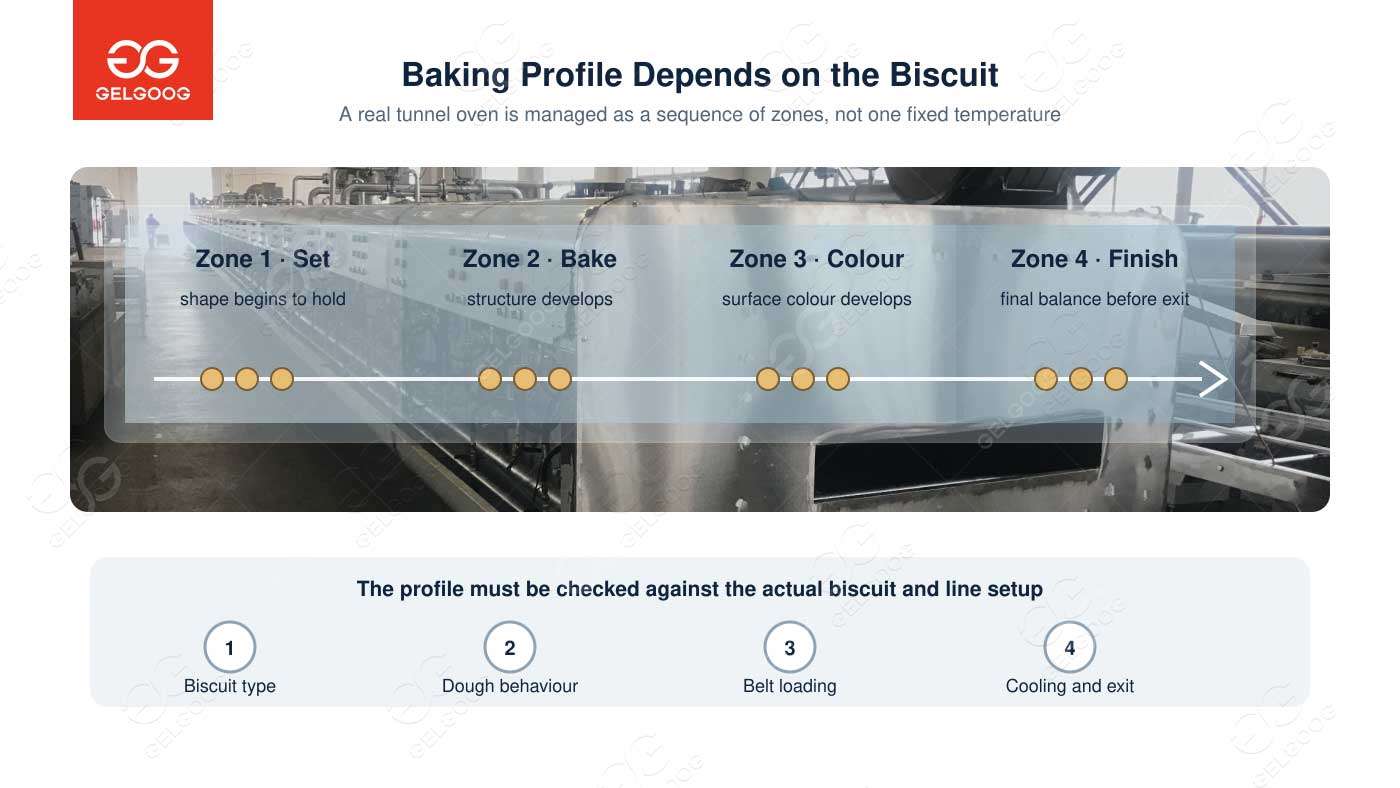
Do Not Select Oven Size From a Capacity Number Alone
A quoted output figure does not by itself define the correct tunnel oven. The oven must also allow the necessary baking time, product loading, belt speed, heat profile, and downstream cooling time for your specific biscuit.
The same production line can have different practical output when it changes from a thin cracker to a thicker cookie or a filled product. Capacity and qualified output can change between products even when the same forming section and oven are used.
For that reason, a project proposal should clearly identify:
the product used as the basis for the proposed oven;
whether the stated capacity refers to dough input, oven discharge, or packed finished product;
the expected operating conditions;
the required baking time and belt-loading assumptions;
the secondary products that may be possible;
the secondary products that require further evaluation or a different configuration.
Before using any nominal kg/h figure to select an oven, review How to Calculate the Real Output of a Biscuit Production Line. It explains why machine output, oven discharge, and qualified packed output are not the same basis for a project decision.
A complete Biscuit Cookie Production Line should be planned as a connected system. The forming section, tunnel oven, cooling conveyor, handling equipment, and packaging line must match the same realistic operating target.
Confirm Utilities and Factory Conditions Before Finalising the Oven
Many oven problems are not caused by the baking chamber itself. They result from incomplete utility planning, inadequate ventilation, insufficient factory space, poor access for maintenance, or a mismatch between the oven and surrounding equipment.
Before a final design is approved, check the following items.
Gas supply and installation conditions
For a gas-heated project, confirm the available gas type, pressure, local installation requirements, combustion-air conditions, ventilation route, exhaust arrangement, and safety provisions. These details may change the required site work and should not be left until after the equipment is shipped.
Electrical capacity
For an electrically heated oven, confirm the available voltage, installed capacity, load-management requirements, cable routing, and the impact on other equipment in the factory. The oven must be evaluated together with mixers, forming equipment, cooling systems, packaging machines, compressors, and auxiliary systems.
Space, logistics, and maintenance access
A tunnel oven requires more than its body dimensions. The project must allow for infeed and discharge areas, cooling conveyors, operator access, service space, exhaust or ventilation systems, and safe material flow.
The layout should also answer practical questions:
Where will dough enter the forming section?
How will baked biscuits transfer to cooling?
Is there enough cooling route before packaging?
Can operators access key service points safely?
Can the oven be installed and maintained without blocking other production areas?
Does the finished-product flow move logically toward packing and dispatch?
Match the Oven With Cooling and Packaging
A biscuit leaving the oven is not always ready for packaging. If cooling is insufficient, the product may be more vulnerable to breakage, condensation, deformation, or packaging problems.
The oven selection should therefore be checked with the cooling route and packaging format. This is particularly important for thin crackers, stacked products, individually wrapped cookies, and biscuits that need gentle handling before entering a wrapper.
The project discussion should confirm:
the expected product condition at oven discharge;
cooling time and conveyor arrangement;
product transfer points between the oven and the packaging section;
risks of breakage, accumulation, or moisture pickup;
the pack format, count, and feeding method;
how rejected or damaged biscuits will be handled.
A fast oven does not improve the commercial result if the cooling or packaging section becomes the bottleneck.
Agree Trial and FAT Criteria Before Production Starts
Agree the product, test conditions, and acceptance criteria before FAT and commissioning.
The right time to define these points is before the line enters regular production, when the product, operating basis, and quality requirements can still be reviewed together.
A useful biscuit tunnel oven acceptance checklist can include:
product type, recipe characteristics, dimensions, and weight basis;
belt condition and normal operating speed;
agreed baking time and planned loading condition;
appearance requirements, including shape and colour;
texture and moisture-related checks agreed by the project team;
product breakage and transfer condition after cooling;
stability of temperature control under the agreed test conditions;
cleanability and access points relevant to the supplied configuration;
utility and safety functions included in the agreed scope;
compatibility with the connected forming, cooling, and handling sections.
The final result should be verified through sample testing, agreed trials, or FAT conditions. A generic equipment demonstration does not replace testing with the product that the factory actually plans to sell.
Frequently Asked Questions
Is gas heating always the best option for a biscuit tunnel oven?
No. Gas may be suitable for some industrial projects, but the right option depends on the available gas supply, product requirements, utility costs, local installation conditions, safety requirements, and the planned operating schedule. It should be evaluated for the specific project.
Can one tunnel oven bake crackers, cookies, and filled biscuits?
A single oven may support more than one product, but this should not be assumed. Different products can require different forming conditions, baking curves, belt loading, cooling time, and handling methods. The oven should first be configured around the main commercial product.
Does a longer tunnel oven always give better baking results?
No. Oven length must match the product’s required baking time, operating speed, loading condition, and factory layout. An oversized oven can increase investment, occupied space, and operating complexity without improving the target product.
Why should I provide a biscuit sample before choosing an oven?
A biscuit sample or detailed product information helps evaluate the shape, thickness, colour target, texture, filling, inclusions, and likely handling risks. This makes the oven recommendation more relevant than a selection based only on a nominal capacity figure.
Should the oven be selected before the forming machine?
The two decisions should be made together. The forming method affects product dimensions, weight, thickness, and dough condition, all of which influence the baking requirement. A complete proposal should coordinate forming, baking, cooling, and packaging.
What information should I send for an initial biscuit tunnel oven recommendation?
Send a product photo, product dimensions, piece weight, recipe characteristics or dough description, target output, planned working hours, available gas and electricity, factory layout information, and any existing equipment you plan to keep.
Choose the Baking System Around Your Product, Not Just the Heat Source
The right biscuit tunnel oven is not simply a gas oven or an electric oven. It is a baking system configured around your product, your utilities, your factory conditions, and the performance you need at the end of the line.
GELGOOG can help you review the initial oven route for your biscuit project, including the product basis, gas or electric heating options, oven zoning, utility requirements, cooling connection, and acceptance points. Send your biscuit photo, required capacity, factory conditions, and target packaging format to begin the evaluation.
Explore Biscuit Tunnel Oven Options Send Your Project Details WhatsApp Us