
 Fruit Vegetable Processing
 Nuts Processing Solution
 Pastry Processing Solution






A quotation for a biscuit production line may state “500 kg/h.”
But before you compare that figure with another supplier’s offer, you need to ask one question:
500 kg/h of what?
It may mean dough entering the line, biscuits leaving the oven, or finished packs ready for shipment. These are not the same thing.
For a new biscuit factory or an expansion project, the capacity that matters most is the amount of qualified, packed product you can sell—not the maximum mechanical speed shown on a machine specification.
This applies whether you plan to make cookies, rotary-moulded biscuits, soda crackers, cream crackers, filled bear biscuits, or caramelized biscuits. Each product has different forming, baking, cooling, handling, and packaging requirements.
Start With the Product You Need to Sell
The most reliable way to plan biscuit production capacity is to work backward from your sales target.
Do not start by asking, “Which line can produce the highest kg/h?” Start with these questions:
How many packs do you need to sell per day?
What is the net weight of each pack?
How many hours will you actually produce each day?
What biscuit will be your main product?
Will you produce one product continuously or change flavours, sizes, and moulds during the shift?
A target of 10,000 packs per day can mean very different production requirements.
For example, the line configuration for 10,000 individual 30 g cookie packs will not be the same as the configuration for 10,000 packs of 200 g cream crackers. The biscuit weight, piece count, pack arrangement, wrapping speed, and handling method all change.
Your required output should therefore be calculated from the finished product you plan to sell.
Why “500 kg/h” Can Mean Different Things
The same capacity figure can refer to several different production stages. If you do not confirm the basis, two quotations with the same kg/h number may not be directly comparable.
| Capacity basis | What it refers to | Why it may not represent your saleable output |
|---|---|---|
| Dough input capacity | Dough supplied to the forming section per hour | Does not account for baking moisture loss, trimming, rejects, or packaging losses |
| Forming capacity | Product formed before baking | Does not show whether the oven, cooling section, and packer can match the speed |
| Oven discharge capacity | Baked biscuits leaving the oven | Does not include cooling, handling breakage, sorting, or packaging rejects |
| Packaging input capacity | Biscuits supplied to the packaging line | Does not always mean every biscuit becomes a qualified finished pack |
| Saleable packed output | Finished packs meeting weight, appearance, seal, and quality requirements | The most useful figure for production planning and investment decisions |
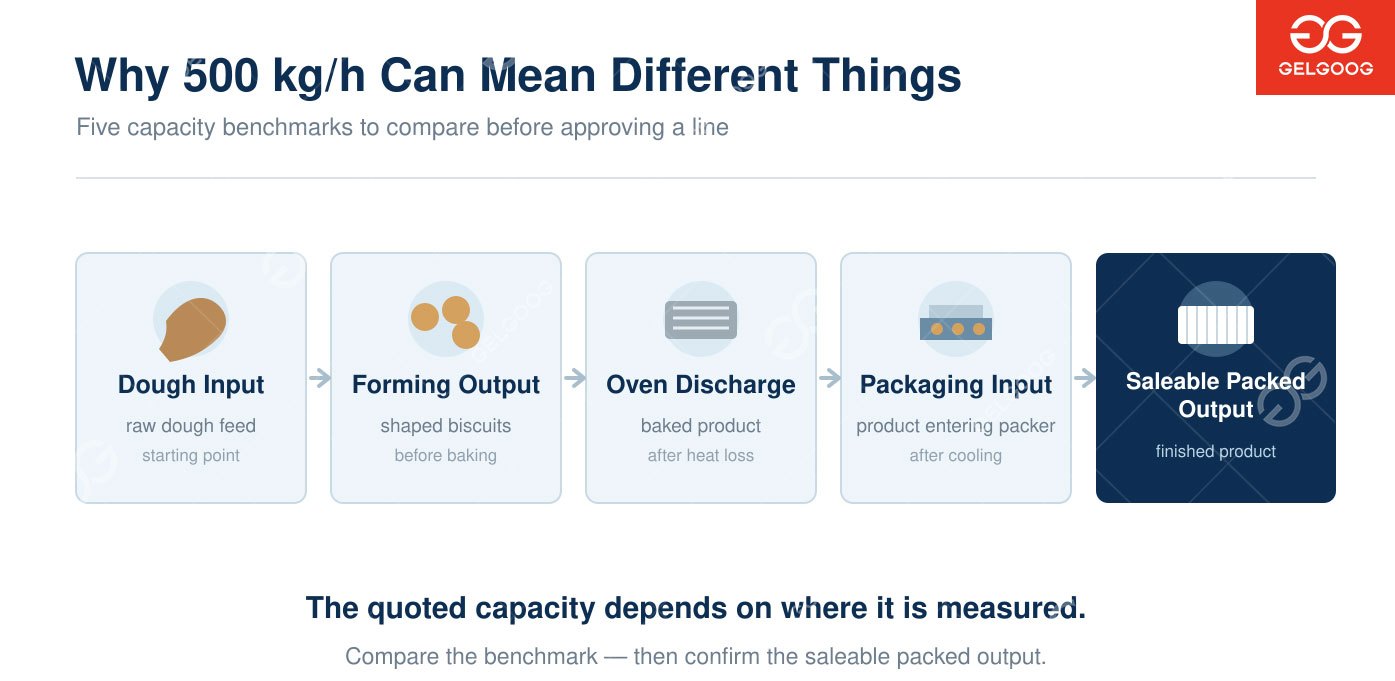
When you review a proposal, ask the supplier to state clearly whether the quoted figure is based on:
dough input;
baked biscuits at oven discharge; or
qualified, packed finished product.
This simple clarification can prevent a major mistake in line selection.
Need to Check What Your Required Capacity Really Means?
Send your target daily packs, pack weight, biscuit photo, and planned production hours. GELGOOG can help convert your sales target into an initial forming, baking, cooling, and packaging capacity requirement.
Calculate Capacity From Your Daily Sales Target Backward
A useful starting point is to convert your daily finished-product target into an hourly target.
Required packed output per hour = Target packed output per day ÷ Effective production hours
For example, if you plan to produce 4,000 kg of packed biscuits per day and have 10 effective production hours:
4,000 kg ÷ 10 hours = 400 kg/h packed finished product
However, 10 scheduled working hours do not always equal 10 effective production hours. In a real factory, you need to allow time for normal production activities such as:
dough preparation and feeding;
start-up adjustment;
oven temperature stabilization;
mould, recipe, or flavour changeover;
packaging film replacement;
quality inspection;
cleaning;
minor stoppages and product handling.
For this reason, your line should not be selected only according to a theoretical daily output divided by total shift hours.
A more practical planning formula is:
Required stable line output = Target packed output ÷ Effective production hours ÷ Expected qualified-output factor
The qualified-output factor should be confirmed from your product type, trial results, normal handling losses, and packaging requirements. It should not be assumed from a supplier’s maximum mechanical speed.
Baking Weight Loss Changes the Capacity Calculation
Dough weight and finished biscuit weight are not identical.
During baking, biscuits lose moisture. The actual weight change depends on the recipe, dough moisture, product thickness, baking curve, target final moisture, and product structure.
A thin soda cracker, a cream cracker, a butter cookie, and a filled bear biscuit do not behave in the same way. A line configured for one product may have a different practical output when running another product.
Before finalizing a capacity proposal, you should provide the following information.
| Information | Why it matters |
|---|---|
| Main biscuit type | Determines the required forming and baking route |
| Product photo or drawing | Helps confirm shape, thickness, and handling risk |
| Biscuit dimensions and piece weight | Used to calculate pieces per minute and pack count |
| Dough condition or main recipe characteristics | Influences mixing, forming, and baking behaviour |
| Finished moisture target | Affects oven design and crispness control |
| Pack weight and packaging format | Converts kg/h into packs per hour |
| Daily output target | Defines the required stable line capacity |
| Planned shifts and actual operating hours | Helps avoid oversizing or undersizing the line |
You do not need to have a final industrial recipe before the first project discussion. But if you can provide your target product sample, approximate piece weight, and intended package, the capacity calculation will be much more accurate.
The Forming Machine, Oven, Cooling Section, and Packer Must Match
A biscuit line does not achieve its commercial output because one machine is fast. It achieves output because every section can run together at a stable speed.
The complete production route normally includes dough preparation, forming, baking, cooling, handling, and packaging. A biscuit production solution should therefore be evaluated as one connected system rather than as separate machines with unrelated capacity figures.
| Production section | Capacity question to confirm | What can happen if it does not match |
|---|---|---|
| Dough mixing and feeding | Can dough be supplied continuously at the planned speed? | The forming section stops or runs inconsistently |
| Forming | Can the machine maintain the target weight, shape, and thickness? | Product size variation, deformation, or unstable output |
| Baking | Does the oven provide the required baking time and heat profile? | Underbaking, excessive colour, poor texture, or moisture variation |
| Cooling | Is there enough cooling time before packing? | Condensation, breakage, deformation, or sealing problems |
| Product handling | Can the biscuits transfer gently between sections? | Higher breakage and lower qualified output |
| Packaging | Can the wrapping system match the required pieces or packs per minute? | Product accumulation and a reduced practical line output |
For many projects, the oven is not simply a heating machine. It determines the available baking time, product moisture, colour development, and line speed. The oven should be matched to the target biscuit rather than selected only by its length or heating source.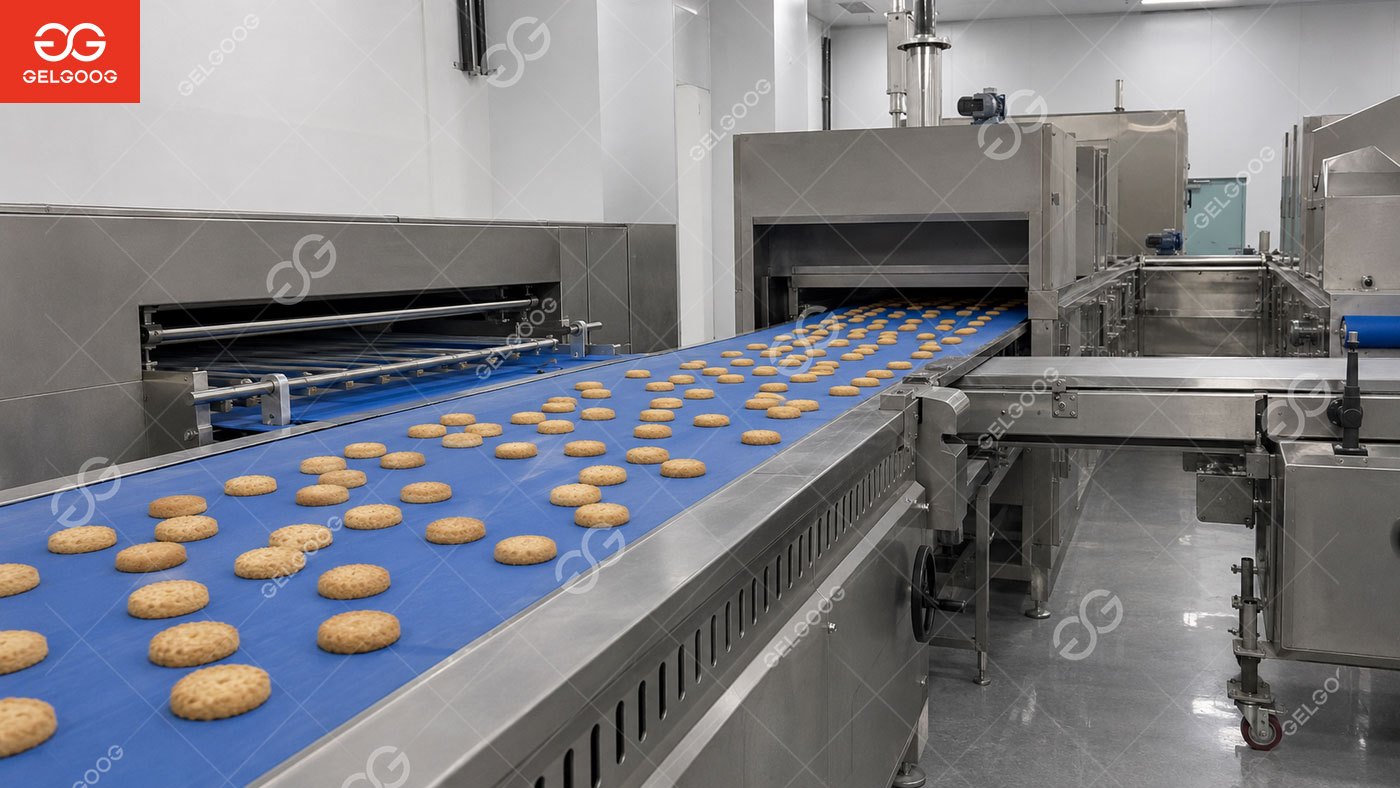
Why Packaging Can Limit the Whole Line
A factory may have enough forming and baking capacity but still fail to achieve its planned output if the packaging section cannot keep up.
This is especially important for:
thin and fragile soda crackers;
cream crackers packed in stacks;
individually wrapped cookies;
small animal-shaped biscuits;
centre-filled bear biscuits;
biscuits with strict pack-weight requirements;
products requiring multiple biscuits in each pack.
For these products, you need to calculate more than kg/h. You also need to check:
pieces per minute;
biscuits per pack;
packs per minute;
packaging lanes;
stacking or counting method;
rejected-product handling.
For example, a biscuit weighing 10 g requires approximately 100 pieces to make 1 kg. If the required finished output is 300 kg/h, the production and packaging system may need to handle around 30,000 pieces per hour before considering normal rejects and pack configuration.
That is why the pack format should be defined before the final line layout is confirmed.
One Line Does Not Have the Same Output for Every Biscuit
Many biscuit factories want flexibility. They may want to make butter cookies, tough biscuits, crackers, animal-shaped biscuits, or seasonal products on the same production line.
This can be possible, but each product should have its own expected output range.
A simple biscuit with a stable shape may run at a higher speed than a product that requires:
a thicker dough piece;
a detailed mould pattern;
centre filling;
a longer baking time;
a precise final moisture level;
gentle transfer to prevent breakage;
frequent flavour, mould, or recipe changes.
Therefore, your quotation should distinguish between:
maximum mechanical speed;
recommended stable operating speed;
expected capacity for your primary product;
expected output range for secondary products.
Do not select a line based on its best-case output for a product that you will only make occasionally.
Use Qualified Output Instead of Gross Output
Gross output is the quantity produced before quality losses. Qualified output is the quantity that meets your agreed standards and can be packed and sold.
The difference may include:
incorrect biscuit weight;
shape deformation;
broken biscuits;
uneven colour;
underbaked or overbaked pieces;
filling leakage or off-centre filling;
poor sealing;
incorrect pack count or pack weight;
damaged packs during handling.
The goal is not to assume a fixed loss percentage before a project begins. Actual results depend on the product, process controls, material quality, equipment setup, operator training, and packaging method.
The right approach is to identify the likely quality-control points before purchasing equipment.
For example:
| Product type | Capacity-related control points |
|---|---|
| Butter cookies and short biscuits | Dough consistency, depositing accuracy, shape retention, baking colour |
| Tough or rotary-moulded biscuits | Dough development, mould release, thickness consistency, oven dwell time |
| Soda crackers and cream crackers | Sheeting thickness, docking, baking moisture, stacking, breakage control |
| Centre-filled bear biscuits | Filling flow, filling weight, centring, sealing, product appearance |
| Caramelized or speculoos-style biscuits | Sugar-related sticking, mould release, colour development, dimensional stability |
This is also why GELGOOG does not recommend treating every biscuit as the same project. The forming method, oven, cooling route, and packaging plan should follow the actual product you want to sell.
A Simple Checklist Before Requesting a Proposal
Before you request a detailed biscuit production-line proposal, prepare the information below.
| What to prepare | Example |
|---|---|
| Finished product | Soda cracker, butter cookie, filled bear biscuit, caramelized biscuit |
| Product image | Front, side, and cross-section view if the biscuit is filled |
| Piece dimensions | Length, width, thickness, or diameter |
| Piece weight | For example, 8 g per piece |
| Package format | 80 g pillow pack, 200 g stack pack, bulk carton, or individual pack |
| Target output | For example, 2,000 kg/day or 15,000 packs/day |
| Planned working schedule | One shift, two shifts, or continuous production |
| Existing equipment | Current oven, mixer, packaging machine, or cooling conveyor |
| Factory conditions | Space, electricity, gas type, compressed air, and local installation conditions |
| Product expansion plan | Whether you plan to add flavours, moulds, fillings, or new pack sizes |
If your factory already has some equipment, this information also helps determine whether you need a complete line or a phased upgrade.
Frequently Asked Questions
Is the highest kg/h capacity always the best choice?
No. The right choice is the capacity that can consistently achieve your sales target with your actual product, working hours, utilities, and packaging format. A line that is too large may create unnecessary investment and operating pressure.
Should I compare dough input capacity or finished-product capacity?
You should primarily compare qualified packed finished-product capacity. Dough input is important for mixer and forming selection, but it does not show how much product you can actually sell.
Can one biscuit line produce cookies, crackers, and filled biscuits?
A flexible solution may be possible, but these products can require different forming, baking, cooling, filling, handling, and packaging conditions. The line should first be configured around your main commercial product.
Why does the biscuit weight matter?
Biscuit weight determines pieces per minute, oven loading, package count, wrapping speed, and total daily output. Even small differences in piece weight can change the required line and packaging capacity.
Why is effective production time lower than total shift time?
A shift includes necessary start-up, adjustment, cleaning, product changeover, quality checks, packaging-material replacement, and minor stoppages. Capacity planning should use realistic effective operating time.
What information should I send to get an initial capacity recommendation?
Send your biscuit photo, piece weight, pack format, target packs or kilograms per day, planned operating hours, and any existing equipment you plan to keep.
Plan for Saleable Output, Not Just Machine Speed
The right question is not:
“What is the highest kg/h this machine can reach?”
The better question is:
“How many qualified packs of my target biscuit can this complete line produce consistently under my planned operating conditions?”
GELGOOG can help you convert your target daily packs into an initial requirement for forming, baking, cooling, handling, and packaging. Send your product photo, target capacity, pack specification, and factory conditions to start the evaluation.