Fruit Vegetable Processing
 Nuts Processing Solution
 Pastry Processing Solution





A Practical Guide to Product Selection, Packed Output, Equipment Configuration, Factory Conditions and Project Scope
A request for “a 500 kg/h biscuit production line” does not define a factory project.
The figure may refer to ingredients, dough, biscuits leaving the oven, or qualified packages ready for sale. It also says nothing about the biscuit type, pack format, cooling requirement, factory utilities, or equipment included in the supply scope.
This is why two quotations with the same kg/h figure can cover very different lines and investments. Start with the biscuit you intend to sell, then define the packed-output target, process route, factory conditions, and project boundary. That sequence gives suppliers the information needed to prepare a relevant proposal and gives buyers a sound basis for comparison.
Start With the Biscuit You Plan to Sell
The product comes before the machine.
A cracker, rotary-moulded biscuit, wire-cut cookie, deposited biscuit, and cream sandwich biscuit do not use one identical route. The dough condition, forming method, baking requirement, cooling arrangement, and final packaging handoff change with the product.
| Product Family | Main Process Difference | Planning Implication |
|---|---|---|
| Hard biscuits / crackers | Sheeting, laminating where required, cutting | Forming and baking route |
| Cookies / soft biscuits | Rotary moulding, wire cutting, or other defined forming | Dough and forming selection |
| Deposited biscuits | Controlled depositing | Product weight and depositing control |
| Sandwich biscuits | Base biscuit plus cream preparation and sandwiching | Cooling, secondary processing, and packaging |
Define the main product first, then list the products planned for future expansion. Record the piece weight, dimensions, thickness, shape, filling or coating requirements, and intended pack format.
Packaging needs to be decided early. Bulk cartons, retail stack packs, individual wraps, and multi-piece packs require different product grouping, count control, transfer, and wrapper speeds. Product variety also affects the project: a line running one product for long campaigns has different priorities from one that changes moulds, flavours, or pack sizes frequently.
The selection between sheeting, laminating, rotary moulding, wire cutting, and depositing follows the recipe, dough condition, final shape, and selling format. There is no standard configuration for every biscuit. For an overview of connected industrial equipment, see the biscuit production line solution.
Plan Capacity From Packed Output
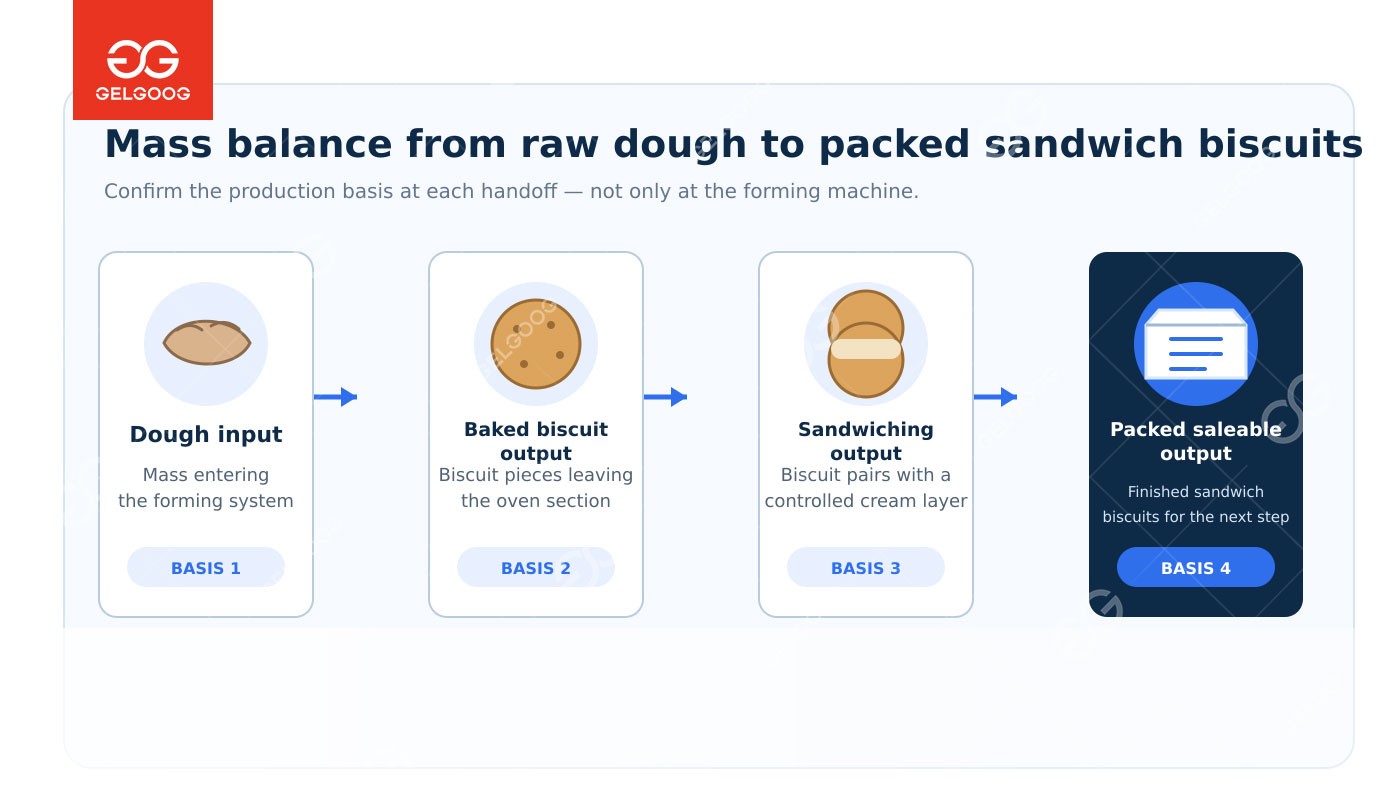
Use qualified packed output as the commercial planning basis. That is the product the factory can ship and sell.
| Capacity Basis | What It Refers To | Why It Requires Clarification |
|---|---|---|
| Raw material input | Ingredients entering production | Does not show finished biscuit output |
| Dough processing capacity | Dough supplied to forming | Does not include baking loss or downstream rejects |
| Baked biscuit output | Biscuits leaving the oven | Does not include cooling, handling, or packaging losses |
| Final packaged output | Qualified packs ready for sale | Best basis for production planning |
The difference between these figures comes from recipe conditions, baking moisture loss, handling breakage, quality checks, product transfer, pack count, sealing quality, and normal operating interruptions.
A simple illustrative planning example is:
Required packed output per hour = Target packed output per day ÷ Effective production hours
A factory targeting 4,000 kg of packed biscuits per day with 10 effective production hours needs an initial planning target of 400 kg/h of packed output. This example is not a GELGOOG equipment-performance claim or a customer case.
The next question is whether forming, baking, cooling, transfer, and packaging can sustain that target. Effective production hours are lower than scheduled shift hours because start-up, product adjustment, packaging-film replacement, quality checks, cleaning, and changeovers take time.
For a detailed explanation of output definitions, read How to Calculate the Real Output of a Biscuit Production Line.
Choose the Process Route Before Selecting Equipment
A biscuit line follows a connected route:
Ingredient preparation → Mixing → Forming → Baking → Cooling → Secondary processing where required → PackagingIngredient preparation and mixing establish the dough condition required by the selected recipe and forming route. Forming controls shape, thickness, unit weight, and product arrangement before baking. Baking develops the product structure, colour, and moisture condition. Cooling prepares the biscuits for transfer, filling, stacking, and packing.
The process branches at forming and secondary processing. Crackers and hard biscuits use a sheeting and cutting route, with laminating included where the product requires it. Cookies use a defined forming method suitable for their dough and shape. Deposited biscuits require controlled depositing. Sandwich biscuits add cream preparation, sandwiching, and finished-product handling after the biscuit base has cooled.
Confirm the process route first. It determines the forming method, oven requirement, cooling arrangement, and packaging handoff.
Match Forming, Baking, Cooling, and Packaging as One System
A biscuit factory achieves its commercial output through the whole connected line, not through the highest nominal speed of one section.
Forming sets the product’s shape, thickness, unit weight, and line rhythm. The tunnel oven must match the product route, target output, product loading, and available factory energy conditions. Cooling then delivers biscuits in a stable condition for transfer, filling, stacking, and packing.
A wrapper needs cooled biscuits to arrive in a stable count, spacing, orientation, and condition. If that handoff is unstable, packaging—not the oven—sets the practical output.
| Section | Main Planning Question |
|---|---|
| Forming | Does it suit the product shape, weight, and dough route? |
| Baking | Does the oven match the required product route and output? |
| Cooling | Can biscuits reach stable handling and packing condition? |
| Secondary processing | Can sandwiching or coating keep pace with biscuit flow? |
| Packaging | Can pack rate and arrangement match qualified upstream output? |
The slowest sustained section sets the commercial output. A fast oven does not increase packed output when cooling, sandwiching, or wrapping cannot absorb its discharge.
For sandwich biscuits, the cooled base biscuits must arrive consistently at the sandwiching section, and the finished product must then transfer to packaging without disrupting its alignment or count. The same principle applies to crackers requiring careful stacking and cookies packed in multiple configurations.
Tunnel-oven selection belongs within this wider line discussion. Heating method, oven length, conveyor speed, temperature-zone arrangement, ventilation scope, fuel availability, and connected cooling capacity must be reviewed together. See Biscuit Tunnel Oven: What to Confirm Before Choosing Gas or Electric Heating and the Industrial Baking Tunnel Oven for Biscuit & Cake.
Need an Initial Line Route Review?
Share your biscuit photo, piece weight, target packed output, pack format, and factory location. GELGOOG can help identify the production route and the project inputs requiring confirmation before a final proposal.
Define Factory Conditions and Total Project Scope
The factory building and site utilities are part of the project decision.
The layout needs room for raw-material receiving and storage, mixing, forming, baking, cooling, packaging, finished-product storage, maintenance access, and personnel movement. Equipment also needs a practical delivery and installation route through the building.
Confirm the following before finalizing the line arrangement:
Factory dimensions, ceiling height, access doors, and installation route;
Maintenance clearance and operating space;
Electrical power, heating fuel, compressed air, ventilation, exhaust, and drainage;
Raw-material, packaging-material, and finished-product storage;
Existing equipment that will remain in use;
Future expansion space and product-flow direction.
The project scope reaches beyond the main forming machine and tunnel oven. Auxiliary conveyors, cooling equipment, product transfer, packaging, factory preparation, utility connections, installation responsibility, and commissioning all affect the total supply boundary.
Price the project after the product route, packed-output target, factory condition, and supply boundary are known. It prevents a later surprise that cooling, transfer, utility connection, or installation work was outside the quoted scope.
What to Prepare Before Requesting a Biscuit Line Proposal
You do not need every project detail before contacting a supplier. The information below makes the first discussion more accurate and identifies the assumptions that still need confirmation.
| Information | Details to Provide |
|---|---|
| Biscuit type and photo | Main product, future products, image or sample |
| Product details | Piece weight, dimensions, thickness, and shape |
| Packaging | Pack format, net weight, and pieces per pack |
| Target output | Finished packed output per hour, shift, or day |
| Operating plan | Working hours, shifts, and expected changeovers |
| Factory information | Country, city, building dimensions, and layout limits |
| Utilities and equipment | Available utilities and equipment already in use |
| Project stage | New factory, expansion, upgrade, or replacement |
Start with the information already available; use the first discussion to identify the missing inputs that affect equipment scope and price.
Frequently Asked Questions
How much does it cost to start a biscuit factory?
Cost follows the product route, packed-output target, automation level, oven configuration, packaging format, factory preparation, utility installation, and supply scope. A meaningful budget requires these project inputs rather than a generic factory-price figure.
What equipment is needed for a biscuit manufacturing plant?
A complete project normally includes ingredient and dough preparation, forming, baking, cooling, product transfer, and packaging. Sandwiching, coating, oil spraying, stacking, or other modules are added when the selected product route requires them.
What production capacity should I choose?
Choose capacity from your target saleable packed output, operating hours, product weight, packaging format, and expansion plan. Then confirm that each connected section can sustain the same target.
Can one line produce different biscuit types?
A line can be configured for a defined product family. Each additional product requires review of its dough, forming route, baking requirement, cooling condition, secondary processing, and packaging format.
What information should I prepare before requesting a quote?
Provide the biscuit type, product photo, piece weight, dimensions, target packed output, pack format, operating schedule, factory location, site information, available utilities, and existing equipment.
Request a Biscuit Factory Project Assessment
Share your biscuit product, target packed output, packaging format, operating schedule, factory location, and available site information. GELGOOG can help define a preliminary production route and identify the equipment, factory, and project inputs that need confirmation before a final proposal.