
 Fruit Vegetable Processing
 Nuts Processing Solution
 Pastry Processing Solution






Choosing a green peas freezing line for an Algeria IQF project is mainly a capacity-planning decision. The central question is not “Which freezer should you buy?” but “How much usable pea kernel flow can your factory reliably process during the harvest period?”
Fresh pea pods are not the same as finished frozen peas. They first need to be shelled, washed, inspected, blanched, cooled, dewatered, individually quick frozen, packed, and stored under frozen conditions. Every section must be matched to the real product flow. If the shelling, freezing, packaging, or cold-storage section is undersized, it can become the bottleneck for the whole project.
For Algeria projects, the recommended line configuration should be confirmed from the local harvest window, collection radius, available cold storage, utility conditions, and intended distribution route. GELGOOG can help you convert fresh-pod supply data into an initial processing flow, capacity recommendation, equipment list, and layout discussion.
Start With the Product You Plan to Sell
The suitable line capacity depends first on your finished-product plan. Before selecting equipment, you need to define whether the factory will sell retail packs, foodservice bags, bulk industrial products, or several formats.
Your project should clarify:
Will you receive fresh pea pods or already shelled pea kernels?
Will you sell IQF green peas only, or also mixed vegetables?
Which pack sizes will you use: 500 g, 1 kg, larger foodservice bags, or bulk packs?
Will your buyers be distributors, supermarkets, restaurants, food factories, or cold-chain traders?
Will the line operate only during the pea season, or also process corn, carrots, green beans, or other vegetables?
These choices affect the entire line. A project supplying 500 g and 1 kg bags may need more attention to product appearance, accurate weighing, coding, labeling, and secondary packing. A project supplying bulk frozen peas to food manufacturers may focus more on stable throughput, product consistency, and efficient bagging.
A complete IQF frozen vegetable processing solution should be designed around the commercial product you intend to deliver—not around a single equipment model.
Calculate Capacity From Fresh Pods to Frozen Peas
Your freezer and packaging line should be sized from the actual shelled-pea output after shelling, rather than the weight of fresh pea pods entering the factory. This is the most important calculation in a green peas IQF project.
As an initial planning reference, 1 kg of fresh pea pods may produce approximately 0.5 kg of pea kernels. This represents an approximate 2:1 fresh-pod-to-kernel ratio. The actual yield may vary according to pea variety, maturity, field condition, moisture, and shelling losses.
For example, if you plan to receive 1,000 kg/h of fresh pea pods, the expected shelled pea-kernel flow may be around 500 kg/h before final sorting and processing losses. The IQF freezer, weighing system, packing equipment, and cold storage should be planned around this usable product flow.
| Fresh Pea Pod Input | Approximate Shelled Pea Output* | Main Capacity-Planning Focus | Typical Project Type |
|---|---|---|---|
| 300–500 kg/h | 150–250 kg/h | Build a practical entry-level processing, packing, and cold-storage model | Smaller processor or pilot frozen-vegetable project |
| 800–1,200 kg/h | 400–600 kg/h | Balance shelling, freezing, packaging, and daily raw-material intake | Cooperative, trader, or regional processor |
| 1,500–2,000 kg/h | 750–1,000 kg/h | Coordinate high-throughput processing, refrigeration, shifts, and storage | Industrial project with stable supply |
| Above 2,000 kg/h | Customized | Review collection logistics, utilities, cold storage, and sales volume in detail | Large agricultural or food investment project |
*This is an illustrative planning reference. The actual yield should be confirmed using your local pea variety and raw-material condition.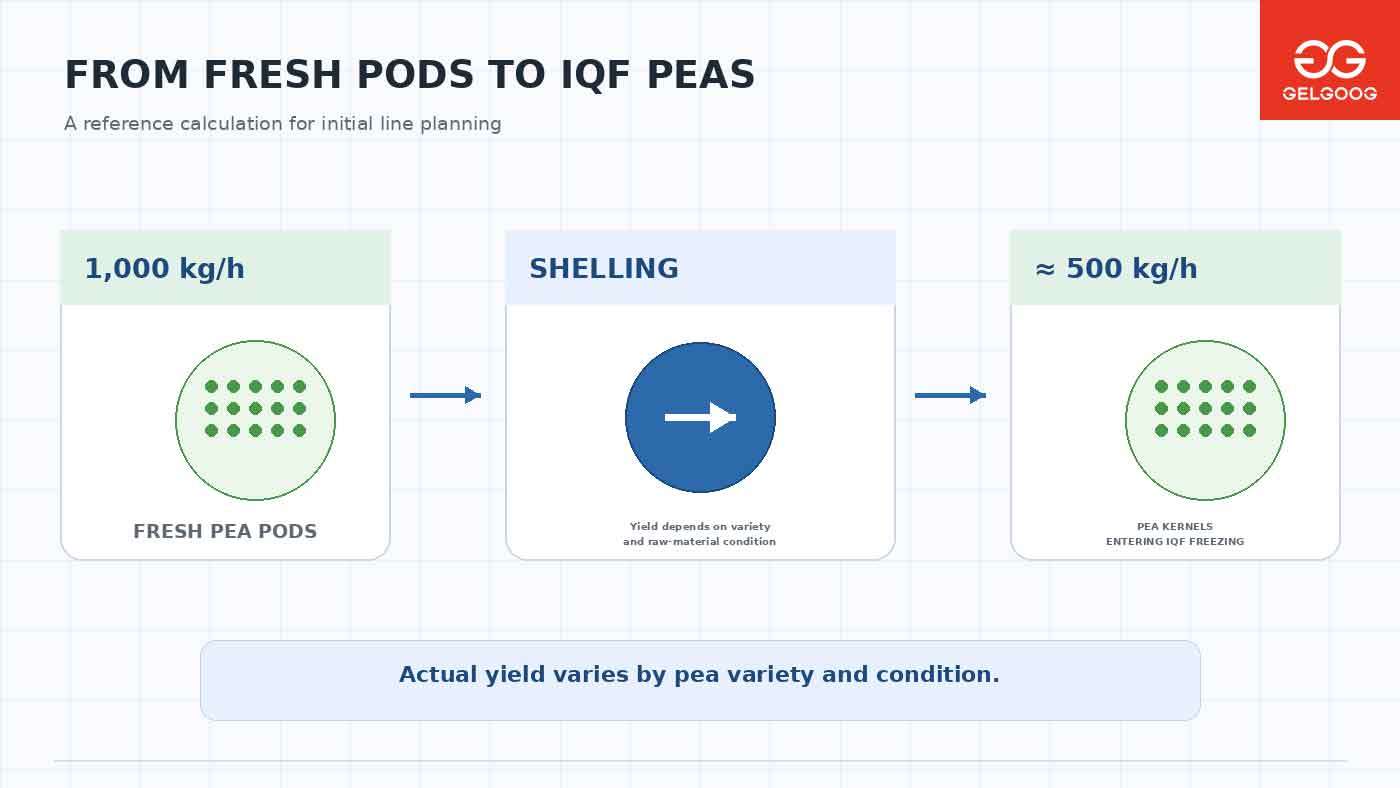
Request a Preliminary Pea Capacity Calculation
Share your expected fresh-pod supply, harvesting period, working hours, and planned pack sizes. GELGOOG can help estimate the usable pea-kernel flow and recommend a matched shelling, IQF freezing, packing, and cold-storage configuration.
Request a Capacity Calculation Discuss Your Project on WhatsAppA correct calculation should include:
Fresh pea pod supply available per day during the main harvest;
Expected shelling yield;
Hours of operation and planned shifts;
Sorting and process losses;
Target finished-product output per hour and per day;
Cold-storage turnover and delivery schedule.
This avoids a common mistake: investing in a freezer that appears large enough on paper but cannot be supplied consistently with prepared peas, or selecting a shelling section that produces more kernels than the freezer and packing area can handle.
Select the Processing Modules as One Connected Line
A green peas freezing line is a connected processing system, not only a pea sheller and IQF freezer. Each section prepares the product for the next stage and helps protect final frozen-product quality.
| Processing Section | Main Function | Main Selection Point |
|---|---|---|
| Raw-material receiving | Receive, inspect, and temporarily buffer fresh pods | Reduce waiting time before shelling |
| Pea shelling | Separate pea kernels from pods | Match pea type and target capacity |
| Washing and separation | Remove loose debris and impurities | Use controlled, gentle product handling |
| Grading and sorting | Improve uniformity and remove unsuitable kernels | Match required product specification |
| Blanching, cooling, dewatering | Prepare peas for frozen storage | Control quality, surface moisture, and product flow |
| IQF freezing | Freeze kernels individually | Match actual prepared pea flow |
| Inspection and packing | Weigh, bag, code, and prepare products for dispatch | Select according to pack size and sales channel |
| Frozen storage | Hold products before delivery | Match production volume and sales turnover |
The shelling section is especially important when you begin with fresh pea pods. It influences the usable kernel output, product breakage, and the load on the sorting section. Before finalizing the configuration, you should provide representative raw-material information, including pea variety, pod condition, expected size range, and planned intake capacity.
After shelling, peas need washing and inspection before blanching. The purpose is to remove impurities, improve product consistency, and prepare a controlled flow for the freezer. Depending on your specification, the line may include size grading, manual inspection, or optical sorting.
Blanching, cooling, and dewatering should be treated as one quality-control section. Blanching helps stabilize product quality before frozen storage; rapid cooling stops the thermal effect; dewatering reduces excess surface water before IQF freezing. The final blanching conditions should be confirmed according to the actual pea variety, size, maturity, target texture, and product standard.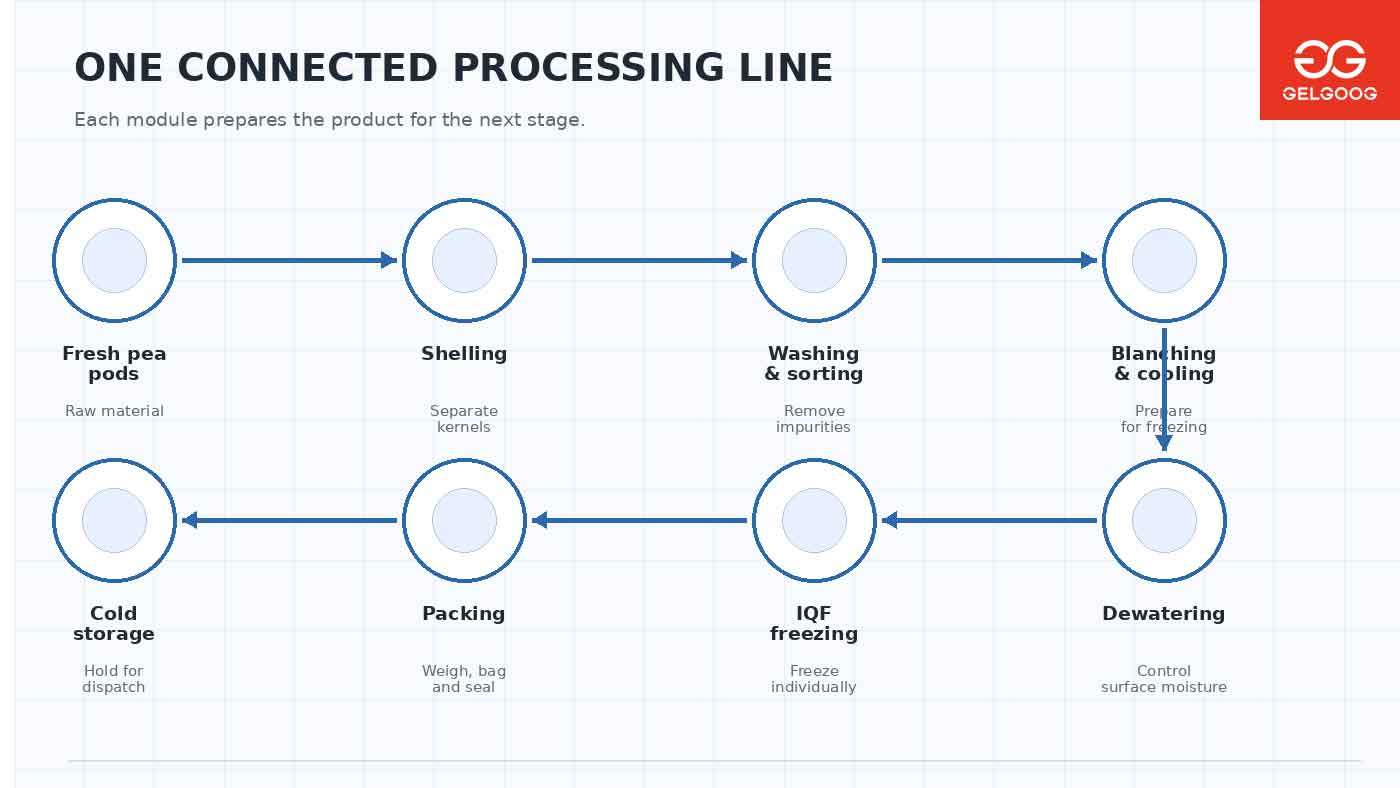
Choose the Right Automation Level
The best automation level is the one that improves output consistency and quality control while remaining suitable for your starting capacity and operating team. Not every project needs the same degree of automation from day one.
A practical way to plan the line is to separate essential processing equipment from higher-specification optional modules.
Basic Configuration for Most Projects
Raw-material conveying and controlled feeding;
Pea shelling;
Washing, separation, and drainage;
Blanching, cooling, and dewatering;
IQF freezing;
Basic inspection and weighing;
Bagging, sealing, coding, and frozen storage transfer.
Optional Modules for Higher Specifications or Future Expansion
Optical sorting;
Automatic product-feed control;
Multihead weighing systems;
Checkweighing and automatic rejection;
Automated labeling or cartoning;
Digital production monitoring;
Additional conveyors and product-transfer automation;
Multi-product changeover modules for other vegetables.
Manual inspection can be useful when raw-material quality varies and the project requires operational flexibility. Optical sorting may be more suitable when you need higher consistency in product appearance or more controlled removal of defects and foreign materials. The selection should depend on your target buyers, labor availability, product specification, budget, and future production plan.
Confirm Utilities and Factory Conditions Before Ordering
Utilities and factory conditions must be confirmed before the final equipment list is approved. A freezing line can only operate as intended when the factory has suitable electricity, refrigeration, water, drainage, space, and cold-storage support.
Before equipment selection, you should verify:
Available electrical capacity for processing, freezing, packing, lighting, and auxiliary equipment;
Refrigeration capacity for the IQF freezer and frozen storage;
Water availability and water quality for washing and processing;
Drainage and wastewater-management conditions;
Compressed-air requirements for selected packing or pneumatic equipment;
Factory dimensions, hygiene zoning, maintenance access, and loading routes;
Available cold-storage volume and expected dispatch frequency.
The IQF freezer should not be evaluated separately from the refrigeration system and cold room. The project must be able to freeze the product, hold it under suitable frozen conditions, and dispatch it without interrupting the cold chain. Energy consumption may vary by capacity, production hours, freezer configuration, refrigeration system, building insulation, ambient conditions, and maintenance practices, so it should be assessed during engineering and layout planning.
Size the Line for the Harvest Window, Not Only Annual Volume
Seasonal supply determines how intensively your factory must operate during the pea harvest. A line that looks sufficient when calculated from annual volume may be too small if most raw material arrives in a short collection period.
For Algeria projects, you should base your capacity calculation on the actual harvest window, collection radius, supplier agreements, transport schedule, and daily delivery pattern. Fresh pea pods should enter processing as quickly as practical after harvest to help protect tenderness, color, and final product quality.
| Supply Scenario | Raw-Material Pattern | Main Planning Requirement |
|---|---|---|
| Limited and variable supply | Smaller, less predictable daily delivery | Flexible line capacity and controlled initial investment |
| Stable regional collection | Consistent intake during the harvest period | Balanced shelling, freezing, packing, and storage capacity |
| Concentrated high-volume harvest | Large daily supply over a short period | Higher throughput, shift planning, cold storage, and dispatch coordination |
If raw material is concentrated into a short period, you may need to increase daily operating hours or use multiple shifts. The factory must then ensure that shelling, blanching, freezing, packaging, refrigeration, and cold storage can operate at the same pace.
A multi-vegetable plan can improve equipment utilization after the pea season. Depending on the final configuration, compatible products may include sweet corn, diced carrots, green beans, and mixed vegetables. However, each product needs separate process evaluation because its washing, cutting, blanching, sorting, and freezing requirements may differ.
Plan Packaging and Cold Storage at the Same Time
Packaging and frozen storage are part of the capacity calculation, not secondary additions after the freezer is selected. If packing or storage cannot keep pace with the freezer, the line cannot run continuously.
For B2B frozen green peas projects, 500 g and 1 kg bags may be relevant for distributors, retail supply chains, foodservice customers, and frozen-food traders. Larger bags may be more appropriate for restaurants, catering businesses, or food manufacturers. Your planned sales channel should determine the packing format.
The finished-product section may include:
Frozen product inspection;
Metal detection where required by the project standard;
Weighing system;
Bag filling and sealing;
Date coding and labeling;
Cartoning or secondary packing when needed;
Transfer to frozen storage.
Cold-storage capacity should reflect daily production, expected sales turnover, seasonal production concentration, and delivery arrangements. You should also identify how products will reach customers: through regional distributors, centralized frozen warehouses, foodservice suppliers, or your own cold-chain route. An IQF freezer can freeze peas quickly, but it cannot replace frozen storage or temperature-controlled delivery.
Six Questions to Ask Before Requesting a Proposal
A useful equipment proposal should be built from your real project information, rather than from a generic freezer capacity alone. Before requesting a quotation or layout, prepare the following six points:
How many kilograms or tonnes of fresh pea pods can you collect per day during peak harvest?
What is the expected harvest period, and how many hours or shifts do you plan to run?
Will you process fresh pods, pre-shelled peas, or both?
What finished-product capacity and pack sizes do you plan to sell?
What factory area, electricity, water, drainage, refrigeration, and cold storage are already available?
Do you plan to process other vegetables after the pea season?
With this information, GELGOOG can discuss a more relevant process route, equipment configuration, layout direction, and expansion plan. You can also explore GELGOOG’s food processing solutions or contact the engineering team to begin a project discussion.
FAQ: Sizing a Green Peas Freezing Line
Should I size the line from fresh pods or shelled pea kernels?
You should consider both, but the IQF freezer, packing system, and cold storage should be sized from the usable shelled pea-kernel flow. Fresh pea pods include shells and therefore do not represent final frozen product output.
What yield can I use for an initial pea capacity calculation?
A practical initial reference is approximately 2:1, meaning 1 kg of fresh pea pods may provide around 0.5 kg of pea kernels. Your actual yield should be confirmed with the local variety and raw-material condition.
Is an IQF freezer enough to start frozen green pea production?
No. A complete project also needs receiving, shelling, washing, sorting, blanching, cooling, dewatering, packing, refrigeration support, frozen storage, and a viable cold-chain delivery route.
Can the same line process green peas and other vegetables?
It can, if the line is planned as a multi-vegetable project. Each additional product should be evaluated for its own pre-treatment, cutting, blanching, sorting, freezing, and packaging needs.
What should I prepare before asking for a line proposal?
You should prepare your fresh-pod supply, harvest duration, planned working hours, pea condition, target pack sizes, factory dimensions, available utilities, cold-storage plan, and intended sales channel.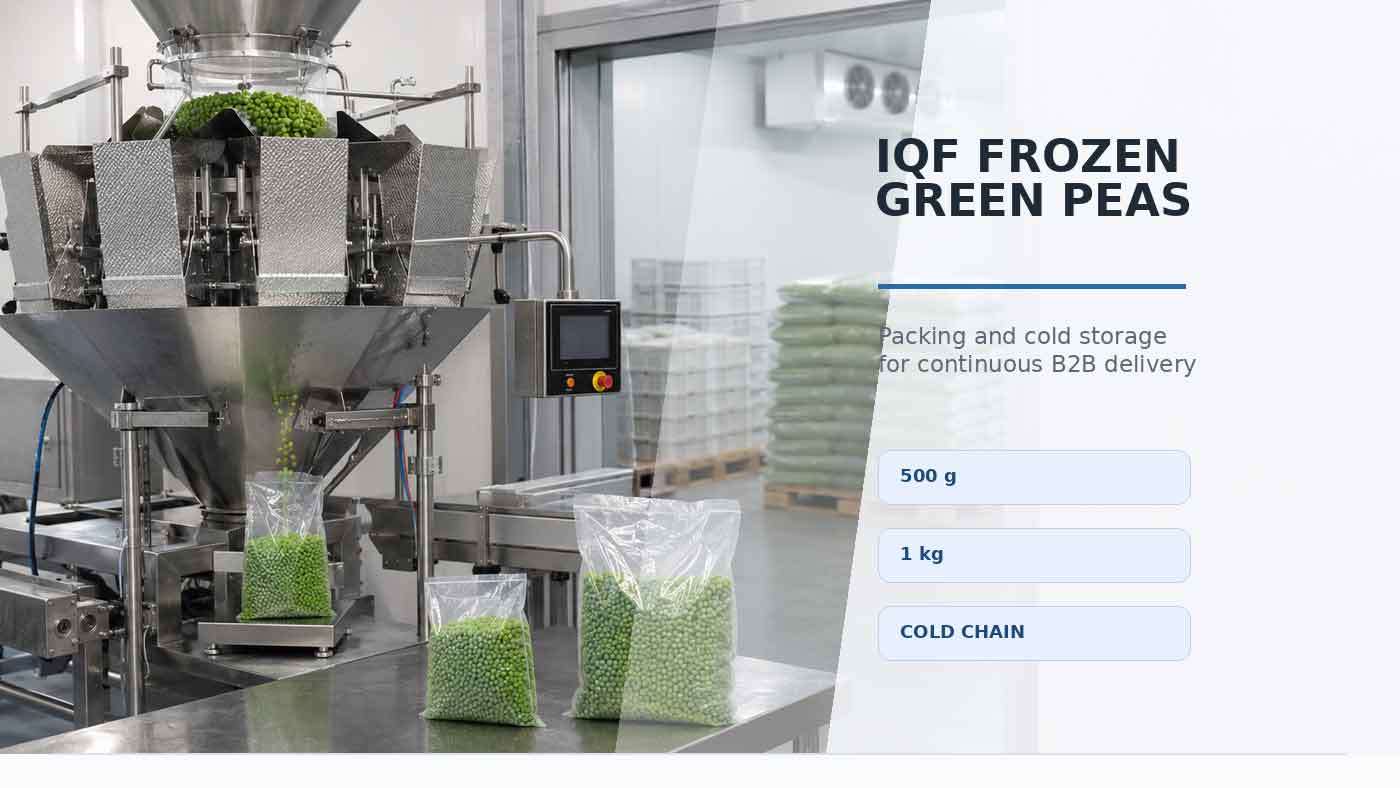
Request a Line Configuration Based on Your Actual Harvest
The appropriate green peas freezing line for an Algeria IQF project should be based on actual fresh-pod supply, realistic shelling yield, harvest concentration, factory utilities, packaging format, and cold-chain capacity.
GELGOOG can help you estimate usable pea-kernel output, define the processing flow, select the necessary equipment modules, and discuss an initial layout based on your project conditions.
Request a Preliminary Proposal Discuss Your Project on WhatsApp