
 Fruit Vegetable Processing
 Nuts Processing Solution
 Pastry Processing Solution






How do you choose the right IQF freezer for fruits and vegetables?
The right IQF freezer should be selected according to the product form, processing capacity, inlet condition, required freezing result, upstream preparation process, and downstream packaging plan. Capacity alone is not enough to determine whether a freezer is suitable.
For fruits and vegetables, the main factors include:
Product type and shape;
Product moisture and surface condition;
Whole, sliced, diced, or cut product format;
Inlet temperature after washing, blanching, or pre-cooling;
Target hourly throughput;
Required freezing consistency;
Available factory space and utilities;
Connection with weighing, packaging, and cold storage systems.
A freezer designed for green beans may not use exactly the same operating conditions as one processing mango dices, pineapple pieces, leafy vegetables, or mixed products. The final configuration should therefore be confirmed according to actual product testing and project conditions.
1. Start with the product form and physical characteristics
Product shape is one of the most important factors in IQF freezer selection. A whole vegetable, a cube, a slice, and a small fruit piece may require different conveying, spreading, and airflow conditions.
| Product format | Typical selection concern | Information to provide |
|---|---|---|
| Whole vegetables | Even distribution and sufficient airflow | Product length, diameter, moisture |
| Diced fruits | Preventing pieces from sticking together | Cube size, surface moisture, inlet temperature |
| Sliced vegetables | Avoiding overlapping and uneven freezing | Slice thickness, width, product density |
| Small fruits or berries | Gentle feeding and separation | Piece size, skin condition, temperature |
| Leafy vegetables | Product spreading and airflow control | Leaf size, cutting format, moisture |
| Mixed products | Compatibility between different products | Product list, processing sequence, cleaning plan |
Before requesting a quotation, you may want to prepare representative samples or detailed product information. The same machine capacity may not apply equally to every material.
For example, the current GELGOOG fluidized-bed IQF freezer range uses green beans as the reference material for its capacity definition. This means the listed capacity should be understood as a reference processing capacity, not a universal guarantee for all fruits and vegetables.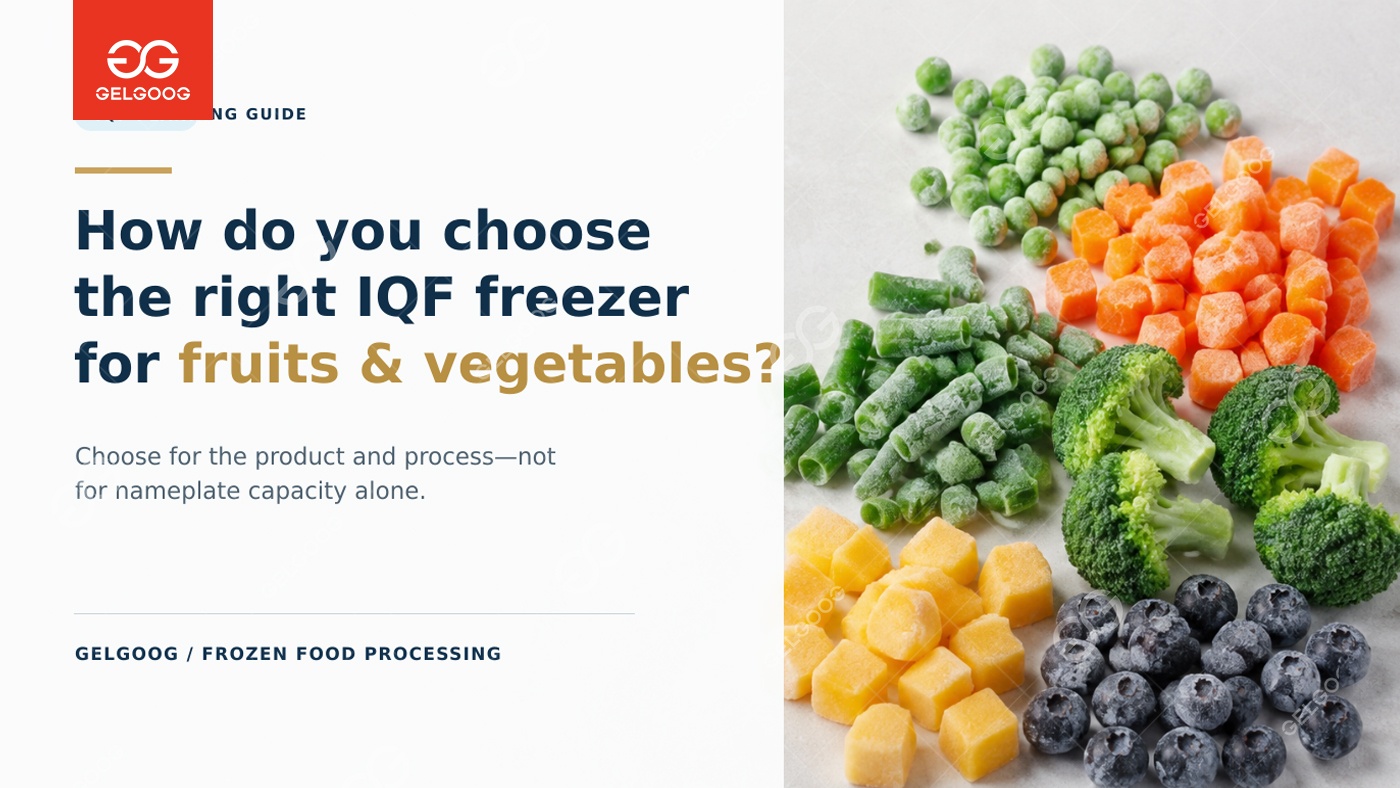
2. Define capacity according to actual production needs
Capacity should be calculated from the required raw material input, operating hours, seasonal supply, and expected product output.
The available GELGOOG fluidized-bed IQF freezer models include reference capacities from 650 kg/h to 5,000 kg/h:
| Model | Reference raw material capacity | Freezer type |
|---|---|---|
| GLSD0650A | 650 kg/h | A-type fluidized-bed IQF freezer |
| GLSD1000A | 1,000 kg/h | A-type fluidized-bed IQF freezer |
| GLSD1500A | 1,500 kg/h | A-type fluidized-bed IQF freezer |
| GLSD2000A | 2,000 kg/h | A-type fluidized-bed IQF freezer |
| GLSD3000A | 3,000 kg/h | A-type fluidized-bed IQF freezer |
| GLSD4000A | 4,000 kg/h | A-type fluidized-bed IQF freezer |
| GLSD5000A | 5,000 kg/h | A-type fluidized-bed IQF freezer |
These figures are based on raw material processing capacity using green beans as a reference product. Actual capacity may vary depending on product shape, bulk density, moisture, inlet temperature, freezing requirements, and operating conditions.
A common mistake is to select a machine based only on the highest possible seasonal supply. This may lead to low utilization during the rest of the year. A better approach is to compare:
Peak-season raw material availability;
Average daily production;
Required operating hours;
Number of production shifts;
Product changeover frequency;
Future expansion plans.
A 1,000 kg/h line may be more practical than a 3,000 kg/h line for a factory with limited raw material supply or an unstable cold-chain market. Larger capacity can be considered when the project has stable raw material sourcing, sufficient packaging capacity, and reliable refrigeration infrastructure.
3. Select the freezing method according to the product
For many cut fruits and vegetables, fluidized-bed IQF freezing can be considered because the product is spread across a moving belt and exposed to controlled cold airflow. This type of system is commonly evaluated for products that need individual separation after freezing.
However, the freezing method should be matched to the product and production model.
A fluidized-bed IQF freezer may be suitable for:
Diced fruits;
Cut vegetables;
Green beans;
Small individual pieces;
Products requiring continuous processing;
Factories planning to connect freezing with automatic packaging.
A batch freezer or blast freezer may be considered for:
Smaller production volumes;
Seasonal or intermittent processing;
Products with irregular shapes;
Projects requiring more flexible batch scheduling;
Factories that are not yet ready for continuous production.
The choice is not simply between “high-capacity” and “low-capacity” equipment. You should also assess product separation, loading method, freezing uniformity, cleaning requirements, and the connection between the freezer and other processing modules.
4. Check the upstream preparation process
An IQF freezer cannot correct every problem created during washing, cutting, blanching, or draining. Product preparation has a direct impact on freezing consistency and final quality.
Depending on the product, the upstream process may include:
Raw material receiving and inspection;
Washing and sorting;
Peeling, trimming, coring, or cutting;
Blanching when required;
Cooling or pre-cooling;
Water removal or vibration draining;
Uniform feeding into the IQF freezer;
Freezing;
Weighing and packaging;
Frozen storage.
Surface water is especially important for diced fruits and cut vegetables. Excess moisture may increase the risk of pieces sticking together or forming ice buildup. For vegetables that require blanching, the product should normally be cooled and drained before entering the freezing section.
It is therefore helpful to review the complete process instead of selecting the freezer as an isolated machine. GELGOOG can evaluate the connection between preparation, feeding, freezing, conveying, and packaging according to your material and capacity requirements. For larger projects, this may include a complete fresh-cut fruit and vegetable processing line.
5. Confirm the equipment scope and refrigeration boundary
One of the most important quotation issues is understanding what is included in the freezer package.
The standard configuration of the referenced GELGOOG fluidized-bed IQF freezer includes:
Freezer enclosure components;
Control cabinet;
1,500 mm belt width;
120 mm insulated panels;
304 stainless steel external and support structures;
Aluminum-alloy evaporator tubes;
Schneider electrical components;
Button-control electrical cabinet.
The standard freezer package does not include the refrigeration unit. The refrigeration system needs to be selected according to the project’s capacity, product characteristics, freezing conditions, and factory utilities.
A complete project quotation may therefore contain separate sections for:
IQF freezer body;
Refrigeration unit;
Refrigerant and refrigeration oil;
Evaporative condenser or related cooling components;
Feeding and discharge conveyors;
Product preparation equipment;
Weighing and packaging equipment;
Electrical installation;
Installation and commissioning;
Spare parts and training.
You can ask the supplier to clearly identify included and excluded items. This helps prevent a situation where the freezer price appears complete but important refrigeration or utility components are not included.
6. Evaluate factory utilities and installation conditions
Factory conditions can affect the feasibility of an IQF project. Before placing an order, you should confirm power supply, water availability, refrigerant arrangements, drainage, equipment access, and installation space.
The referenced equipment uses a standard electrical requirement of:
380 V;
50 Hz;
Three-phase power.
The installation preparation conditions include electricity, water, and refrigerant. Exact utility requirements should be confirmed during technical design because they may vary according to the selected refrigeration system and project capacity.
You may also want to prepare:
Factory layout or available installation area;
Ceiling height and equipment access route;
Floor load information;
Drainage arrangement;
Water supply and cleaning facilities;
Cold storage location;
Packaging area;
Product and personnel flow;
Maintenance access around the equipment.
A freezer may be technically suitable but difficult to install if the factory has insufficient space for refrigeration equipment, poor drainage, or no practical route for product transfer. You can also review the IQF freezer installation and utility requirements before finalizing the factory layout.
7. Consider cleaning, maintenance, and product changeover
Fruit and vegetable processing often involves high moisture, sugar, fibers, skins, and small product particles. Cleaning and maintenance should be considered before equipment selection.
You can focus on the following questions:
Which areas require routine cleaning?
How is water removed after cleaning?
How is frost or ice buildup handled?
Can the belt and product-contact areas be accessed?
What spare parts should be prepared?
How often should key components be inspected?
How long may product changeover take?
For factories processing multiple fruits and vegetables, the cleaning plan becomes even more important. Different products may have different allergen, color, odor, or contamination-control requirements.
You can also confirm with the supplier whether operating and maintenance guidance, installation support, commissioning assistance, and training are included in the agreed project scope. GELGOOG can also support equipment configuration and later line upgrades when you expand capacity or add new products.
8. What information should you send before requesting a quotation?
A more complete inquiry allows the supplier to recommend a more appropriate freezer and refrigeration configuration.
You should provide:
Product name;
Product format and dimensions;
Raw material inlet temperature;
Target frozen product temperature;
Required raw material capacity;
Daily operating hours;
Seasonal or year-round production plan;
Upstream processing steps;
Packaging method;
Available voltage and frequency;
Factory location and climate conditions;
Existing layout or equipment;
Expected delivery schedule.
If the product is new or difficult to freeze, product testing may be required before confirming final capacity and operating conditions.
Frequently Asked Questions
What is the best IQF freezer for fruits and vegetables?
The best IQF freezer is the one matched to the product format, capacity, inlet condition, freezing target, and factory utilities. There is no single freezer configuration suitable for every fruit and vegetable.
Can one IQF freezer process different fruits and vegetables?
One IQF freezer may process multiple products, but compatibility must be evaluated according to product size, moisture, density, freezing requirements, and cleaning procedures. Different products may require different operating adjustments or feeding arrangements.
What capacity does the GELGOOG IQF freezer provide?
The referenced fluidized-bed IQF freezer models cover 650 kg/h to 5,000 kg/h of reference raw material capacity, using green beans as the example product. Actual capacity may vary for other fruits and vegetables.
Does the IQF freezer include the refrigeration unit?
The referenced standard configuration includes the freezer enclosure and control cabinet but does not include the refrigeration unit. Refrigeration equipment should be selected separately according to project requirements.
What voltage does the IQF freezer use?
The default electrical specification is 380 V, 50 Hz, three-phase. Voltage adaptations may be discussed during technical design.
Can the freezer be connected to an automatic packaging line?
Yes, an IQF freezer can be designed as part of a larger processing system with feeding, discharge conveying, weighing, packaging, and cold storage connections. The interfaces should be confirmed during the layout and engineering stage.
Conclusion
Choosing an IQF freezer for fruits and vegetables requires more than comparing model numbers or hourly capacity. Product format, raw material condition, process flow, refrigeration scope, utilities, factory layout, cleaning, and future expansion should all be evaluated together.
For projects using a fluidized-bed IQF freezer, GELGOOG can help review your product information, estimate the suitable capacity range, define the freezer and refrigeration scope, and develop a processing layout from preparation through packaging. Final capacity and operating conditions should be confirmed according to the actual product and project environment.