The global demand for frozen onion rings continues to grow, especially in quick-service restaurants, supermarket private labels, and snack food distribution chains. For investors planning to establish a frozen onion ring factory, one of the most important decisions is selecting the right onion ring production line configuration.A well-designed line does far more than simply coat and fry onions. It determines product consistency, oil absorption level, operating cost, labor requirements, and ultimately your long-term profitability.
If your planned capacity is around 2–5 tons per day of finished product, the production system must balance automation, energy efficiency, and cost control without becoming unnecessarily oversized.
From Raw Onions to Frozen Product: How the Line Works:
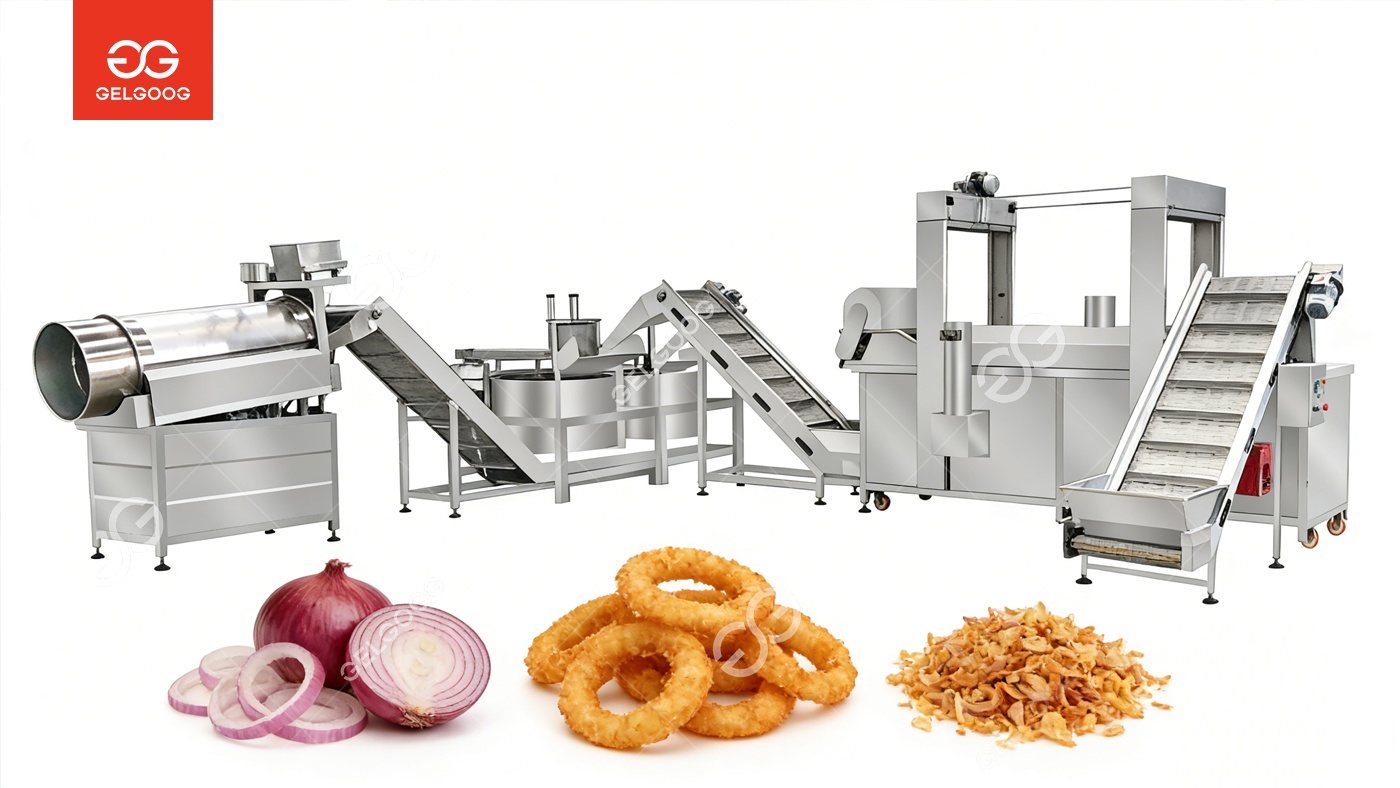
A complete onion ring production line integrates multiple processing stages into one continuous workflow. Each stage plays a specific role in ensuring uniform texture and appearance.
The process begins with industrial onion peeling. Modern peeling machines remove skins efficiently while minimizing flesh loss, ensuring stable raw material quality for downstream processing.
After peeling, onions move to a slicing and ring separating system. Consistent ring thickness is critical, because uneven cuts result in uneven frying and inconsistent coating performance. A properly engineered slicing system ensures uniformity, which directly affects final product quality.
The rings are then washed and air-dried. Removing excess surface moisture improves batter adhesion and prevents coating defects. Without proper drying, onion rings can absorb excess oil during frying.
Next comes the coating section, which usually includes three stages: predusting, battering, and breading. The preduster applies a thin flour layer that improves adhesion. The batter applicator ensures even liquid coating, and the breader applies crumbs or textured coatings to create the crispy exterior consumers expect.
Once coated, onion rings enter a continuous fryer equipped with oil filtration. Precise temperature control forms the outer crust while maintaining moisture inside. Integrated filtration systems extend oil life and reduce operating costs.
After frying, excess oil is removed using a vibrating conveyor or de-oiling system. This step improves texture and reduces greasiness.
Finally, the rings pass through an IQF freezing tunnel. Individually quick freezing locks in structure and prevents clumping. Once frozen, the product is automatically weighed and packed for retail or foodservice distribution.
Why an Integrated Production Line Matters:
For medium-scale factories producing 2–5 tons per day, fragmented equipment setups often create bottlenecks. Manual transfer between machines increases labor cost and contamination risk.
An integrated onion ring production line provides:
Stable daily output
Consistent coating thickness
Controlled oil absorption
Reduced labor dependency
Easier compliance with food safety standards
Lower long-term maintenance cost
When properly designed, the line also includes factory layout planning, power consumption calculation, and labor estimation — all critical factors for new factory investment.
Key Considerations Before Investment
Before selecting equipment, investors typically evaluate:
Target market (retail vs foodservice)
Desired coating type and texture
Local electricity and gas conditions
Available factory space
Budget range
Future expansion plans
Choosing a supplier who can provide layout drawings, energy data, delivery schedules, installation support, and warranty details significantly reduces startup risk.
Building a frozen onion ring factory requires more than purchasing individual machines. A well-engineered onion ring production line ensures consistent product quality, controlled operating cost, and scalable production capacity.
If you are planning a 2–5 tons/day project, obtaining a customized technical proposal based on your factory conditions is the most effective next step.

 Fruit Vegetable Processing
 Nuts Processing Solution
 Pastry Processing Solution